Capacity and capability are two factors that significantly impact an agency’s revenue growth strategy.
The more people you hire, the harder it becomes to manage and as you look for specialists, the margins start getting thin. As a result, most agencies start hand picking clients and eventually hit the ceiling. However, fast-growing agencies do not grow into capacity, they plan for it.
This blog post explores top factors that cause revenue leakage within agencies while providing a comparative view of different types of delivery models. Besides, it outlines agency scalability solutions without needing you to turn down clients’ additional work.
The Growth Paradox: What Makes Scaling Difficult for an Agency
Recent industry insights highlight an increasingly complex challenge for agency leaders. Agency revenue leakage is silently eating into margins, fueled by economic pressures.
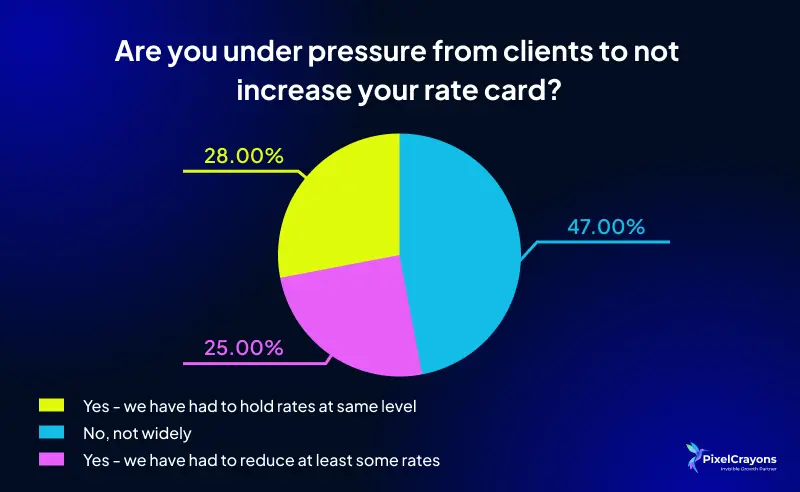
A widely cited survey reveals that 21% of agencies plan inflationary pay rises, but only 11% plan to raise client rates.
This disconnect undermines the agency revenue growth strategy, causing agency leaders to look for scalable agency business models.
Traditional fixed-headcount models struggle under financial pressure. So, the agencies now need smarter delivery methods.
Also Read: Why Growing Agencies Fail at Scale & How White-Label Pods Fix It?
Where Fast-Growing Agencies Hit the Ceiling
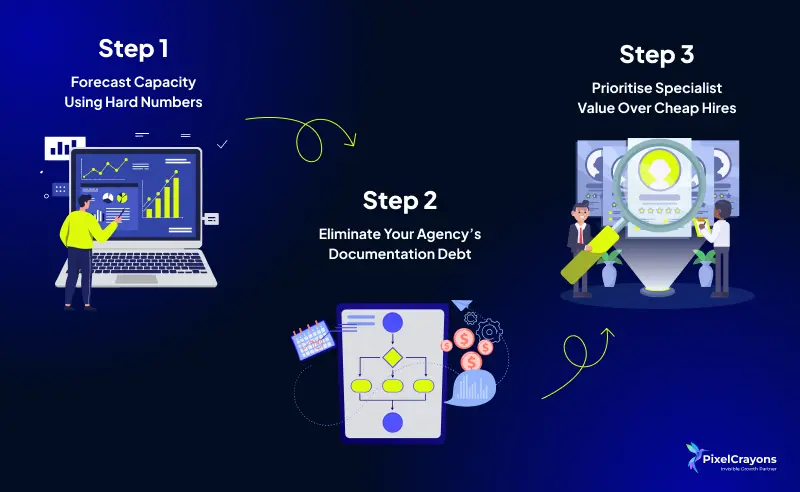
Most agency owners scale by “gut feel”. Hiring when they feel stressed and taking on projects because the numbers look good on paper. Such a reactive approach is exactly what leads to agency revenue leakage.
Here is how a reactive decision starts agency revenue leakage, and what to do about it.
The Capacity Trap
Most agencies don’t actively plan capacity. Work keeps coming in, projects stack up, and suddenly the team is stretched thin.
How to fix: Employ agency capacity planning (billable hours × utilization rate) to forecast intake based on hard numbers, not just the state of your inbox.
The Documentation Debt
The “know-how” of an agency, like its processes, delivery steps, and client context, lives in Slack threads or someone’s memory. As a result, when teams grow or people leave, that knowledge disappears.
How to fix: Document processes and project workflows early. This helps onboard faster and consistently deliver.
The Cheap Hire Fallacy
Hiring junior talent to save on payroll backfires. The hidden costs of constant hand-holding, training, and management overhead exceed the salary of a seasoned specialist who could have hit the ground running.
How to fix: Hire specialists for core roles and white-label partners for overflow.
Scale Faster. Hire Smarter. Go White-Label.
Get expert delivery, predictable capacity, and zero-competition guarantee.
How To Stop Turning Down Clients As An Agency
To stop turning down clients, agencies need more flexible capacity. Improve agency capacity planning, document key workflows, and use options like outsourcing agency projects or white label partnerships. This helps you take on more work without overloading your team or hiring too quickly.
What Growing Agencies Actually Do (Step-by-Step Process)
Goal: A lean agency built for high-value clients, not busywork.
- Document: Systemize everything before you hire, not after.
- Hire: Bring in specialists for core revenue roles.
- Outsource: Delegate execution to white-label partners.
- Focus: Keep leadership on sales, strategy, and growth.
Looking at Scalable Agency Business Models: Comparing Your Options
When agencies hit capacity limits, the question isn’t whether to expand delivery — it’s how. The model you choose directly affects margins, speed, and your ability to take on new clients without overloading your team.
Broadly, agencies choose one of three paths:
- Build an in-house team for internal execution.
- Work with freelancers or contractors for flexible, on-demand capacity.
- Partner with a white-label provider to handle delivery while they manage the client relationship.
Let’s explore how each model works for an agency with a focus on key aspects that are crucial for an agency’s smooth functioning.
Comparing Scalable Agency Business Models
|
|
Aspects
|
In-House Team
|
Freelancers / Contractors
|
White-Label Partner
|
|
How it Works
|
Hire full-time employees
|
Work with independent specialists
|
Partner with a provider under your brand
|
|
Scalability
|
Slow
|
Flexible but inconsistent
|
Highly scalable
|
|
Cost Structure
|
High fixed costs
|
Variable costs
|
Predictable project-based pricing
|
|
Management Effort
|
High
|
Medium–High
|
Low–Medium
|
|
Quality Consistency
|
High
|
Variable
|
Consistent
|
|
Speed
|
Slow initially
|
Fast for specific tasks
|
Fast, ready-to-go teams
|
|
Operational Overhead
|
High
|
Medium
|
Low
|
|
Control
|
Very high
|
Medium
|
Medium–High
|
|
Suitable For
|
Long-term control
|
Flexible short-term support
|
Scaling quickly without internal expansion
|
Option 1: Building an In-House Team
Best for agencies with predictable demand and a steady pipeline of projects. It works well when delivery requires tight collaboration, long-term product knowledge, or proprietary processes that are hard to externalize.
Pros:
- Total control over quality and process
- Strong team culture aligned with agency vision
- Familiarity with clients and workflows
Cons:
- High fixed overhead (salaries, benefits, tools)
- Slow and expensive to scale up/down
- Management overhead
Also Read: How Agency Partnerships Add 30-50% Revenue Without New Headcount?
Option 2: Working With Freelancers or Contractors
Apt for agencies that face fluctuating workloads or need niche expertise for specific projects. Freelancers are useful for short-term execution gaps without committing to permanent hires.
Pros:
- Flexible, on-demand capacity
- Access to specialized skills
- Lower commitment than full-time hires
Cons:
- Inconsistent availability and quality
- Heavy management overhead (vetting, briefing)
- Security and brand consistency risks
Option 3: Partnering With a White-Label Provider
Suitable for agencies that want to scale delivery without expanding headcount. This model allows the agency to focus on sales, client relationships, and strategy while the partner handles execution behind the scenes.
Pros:
- Predictable costs and reliable capacity
- Frees internal team to focus on sales/strategy
- “Behind the scenes” execution under your brand
Cons:
- Requires trust in a third party
Also Read: How Agencies Can Scale with White-Label Services
2,500+ Projects Delivered, Zero Competition With Your Clients
Focus on strategy while we handle execution behind the scenes.
The Zero-Risk Growth Partner
As an agency leader, you should not have to choose between scaling revenue and sleepless nights.
PixelCrayons removes that trade-off entirely. As a white label marketing agency, we give you execution capacity across marketing, development, and design, delivered under your brand, inside your workflow with a zero-competition firewall.
We will never steal your clients, build competing brands, or step into the spotlight. Our white label services for agencies stay completely invisible, so you remain the face of the relationship while we handle delivery.
You Stay in Control. We Stay Invisible.
Backed by 21+ years in business, 100+ agency partnerships, and an 85% client retention rate.
Stop Managing Deliverables and Start Managing Growth With PixelCrayons
For founders and CFOs, growth usually means:
- More payroll
- More risk
- More management headaches
White labeling flips that equation. It becomes your invisible growth partner by letting you sell work you never touch. You win contracts, manage clients, and drive revenue streams while we handle the actual delivery behind the scenes.
Unlike hiring in-house, there is no overhead when things start to slow down. Unlike freelancers, there are no quality risks or last-minute cancellations. We help scale revenue through white label services for agencies, keeping product teams lean and focused on sales, strategy, and client relationships.
Frequently Asked Questions
1. What is Agency Revenue Leakage and why does it happen?
Ans: Agency revenue leakage happens when agencies lose profit due to inefficient delivery, underpriced work, or poor agency capacity planning. It appears as teams being overloaded, projects taking longer than expected, or agencies turning down new work.
2. How can agencies stop turning down clients as they grow?
Ans: The key is better agency capacity planning and adopting scalable agency business models. Many agencies solve this by outsourcing agency projects through white label services for agencies or white label partnerships like PixelCrayons, allowing them to take on more work without increasing headcount.
3. Are white label services a good solution for scaling an agency?
Ans: Yes, white label services for agencies are effective at expanding service offerings and handling higher workloads without building a larger in-house team. . With the right white label marketing agency partner, you can deliver projects under your brand while maintaining quality and control. As a result, the focus is shifting to scaling agencies with white label services to create more predictable and scalable agency business models.
4. What are invisible delivery pod models and how do they help agencies scale?
Ans: Invisible delivery pod models are dedicated teams that work behind the scenes under your agency’s brand. These teams handle execution while you manage the client relationship. This model removes agency operational bottlenecks, supports outsourcing agency projects, and acts as an effective agency scalability solution to grow without expanding internal teams.
5. What are the most common agency operational bottlenecks?
Ans: Typical agency operational bottlenecks include poor documentation, reactive hiring, and limited delivery capacity. Many agencies solve this by working with partners like PixelCrayons, which provide white label overflow support and execution teams to remove delivery bottlenecks without adding internal headcount.
6. What is the best model for scaling an agency without hiring more staff?
Ans: One of the most effective approaches is using agency scalability solutions like white label partnerships or invisible delivery pod models. These models allow agencies to expand services and manage fluctuating workloads while keeping teams lean. Providers such as PixelCrayons improve agency revenue growth strategy without the cost and complexity of hiring full-time staff.

Transforming the Future with White Label Blockchain and AI
I’m a White Label Blockchain & AI Expert with 7+ years of experience, partnering with digital agencies and consulting firms to deliver white-label blockchain, AI, and Web3 solutions for their clients. I work behind the scenes to help agencies scale faster, expand service offerings, and deliver secure, future-ready solutions—under their own brand.
What I Offer to Agencies
White-Label Blockchain Solutions
- End-to-end development of smart contracts, DApps, and enterprise-grade blockchain systems using Ethereum, Hyperledger, Solana, and more.
- Hands-on experience with DeFi platforms, NFT ecosystems, and Web3 infrastructure—delivered seamlessly as your in-house capability.
White-Label AI Integration
- Designing and deploying machine learning models for predictive analytics, automation, and operational efficiency.
- Implementing NLP and AI-powered solutions for intelligent, data-driven decision-making.
- Combining AI with blockchain to build secure, decentralized, and scalable applications for client use cases.
Scalable Innovation for Client Projects
- Helping agencies deliver advanced solutions for identity management, traceability, security, and compliance by merging AI and blockchain technologies—without increasing internal overhead.
Your Trusted White-Label Tech Partner
I’m passionate about enabling agencies to win more projects, reduce delivery risk, and increase margins with reliable white-label Blockchain, AI, and Web3 development support. If you’re looking for a long-term technical partner to strengthen your offerings, let’s collaborate and build impactful solutions—together.
Let’s Connect Linkedin | Facebook
#WhiteLabelServices #BlockchainDevelopment #AIIntegration #Web3 #MachineLearning #DeFi #SmartContracts #AgencyGrowth #EmergingTechnologies