Imagine spending years building SEO visibility and publishing content, only to watch your website traffic decline even when rankings remain strong.
Your audience is no longer clicking through the way they used to. They are getting answers directly from search results.
That is exactly what AI-powered search experiences and Google AI Overviews have introduced.
Search engines now generate instant answers, summaries, and recommendations directly within the SERPs. While this improves convenience for users, it creates a serious challenge for businesses that rely on organic traffic for clicks, leads, and conversions.
In 2026, AI search is dramatically changing how SEO works and redefining how SEO is evolving in 2026 for businesses and agencies alike. In this blog post, we will explore how AI search impacts SEO, the key visibility challenges businesses face, and the strategies brands can use to stay discoverable and competitive.
How AI Search Is Changing User Behaviour: Key Trends
Search behavior is rapidly evolving. AI-powered search experiences have significantly impacted the way users interact with searches.
Here are some key trends reflecting the shift:
- According to SEMrush’s 2025 zero-click study, nearly 60% of all Google searches now end without a click to any website
- As per a study conducted by the Pew Research Center, around 58% of participants had at least one Google search that showed an AI-generated summary.
- Data from Seer Interactive shows organic click-through rates drop by 20% to 40% when AI Overviews are displayed
These trends reflect how AI search is redefining online brand visibility. Also, SEO for AI search engines has become necessary for businesses to remain relevant and competitive.
Future-Proof Your SEO
Build authority that drives long-term visibility.
The Biggest SEO Challenges Brands Will Face in 2026
As AI search continues to reshape user behavior, businesses are facing new challenges that go beyond traditional optimization. Here are some of the major challenges businesses and agencies face in the AI-driven search era.
Declining Organic Traffic
Declining organic traffic despite strong rankings has become one of the biggest SEO challenges in 2026. AI-generated summaries, featured answers, and conversational search experiences now deliver instant information directly within search results. As a result, users no longer need to visit multiple websites for simple answers
This shift is contributing to:
- More zero-click searches
- Lower click-through rates
- Shorter search journeys
- Reduced visibility for informational content
For many businesses, this means traditional traffic growth strategies are becoming less effective.
Content Saturation Is Increasing
The internet is already saturated with content, and AI has accelerated content production even further. However, much of the AI-generated material lacks originality and practical insight. As a result, search engines have become far more selective about what they surface.
For generative engine optimization for brands, one needs to prioritize content that demonstrates the following:
- Original insights
- Topic depth
- First-hand experience
- Practical value
- Genuine expertise
Publishing more content alone is no longer enough to improve visibility in 2026. Content that delivers unique insights and practical value is gaining greater visibility.
Building Authority Is Becoming More Difficult
Building topical authority is emerging as a major ranking factor in AI-powered searches. Instead of focusing mainly on keyword rankings, brands now need their content to be recognized and referenced by AI tools and chatbots.
Visibility is now influenced by:
- Brand reputation
- Expert contributions
- Reviews and reputation
- Brand mentions
- PR coverage
Brands that consistently demonstrate expertise and industry trust are more likely to gain visibility in AI-driven search results, making answer engine optimization for brands increasingly important in 2026.
SEO Reporting Is Becoming More Complex
Traditional SEO reporting is becoming more complex. Users now discover and interact with brands across AI search engines, social platforms, and conversational interfaces. As a result, rankings and traffic alone are no longer enough to measure performance.
Businesses and agencies increasingly need to track the following:
- Brand visibility
- Engagement quality
- Branded search growth
- Conversion quality
- AI citation frequency
- Share of search visibility
Ultimately, clients care about business impact, not just rankings.
AI Search Is Stealing Your Clicks
Find where visibility is being lost.
What will matter most for SEO visibility in 2026?
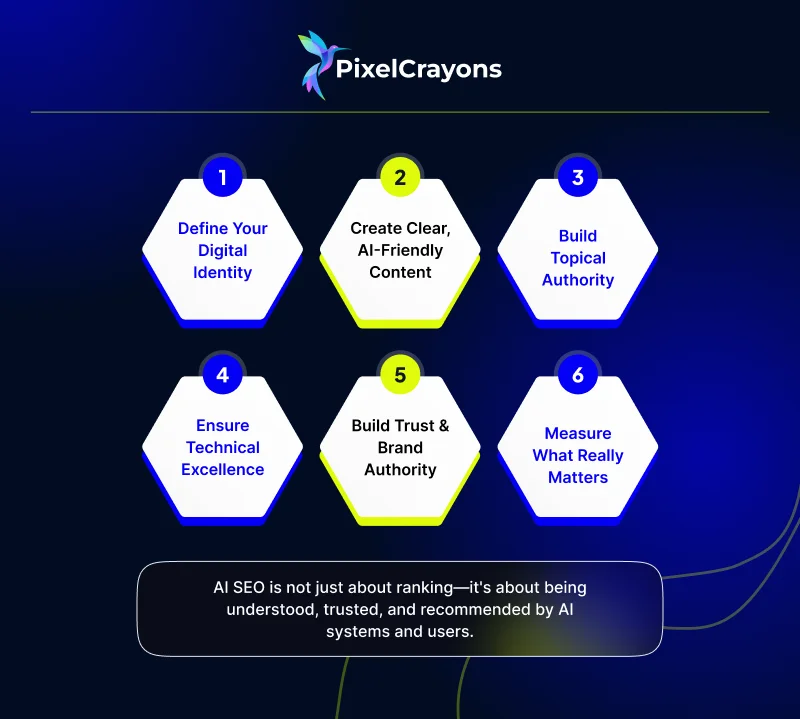
In 2026, AI-driven SEO visibility will reshape how search engines evaluate relevance, authority, and usefulness. Search engines are moving beyond matching keywords to queries to rank pages. That said, AI search optimization will require more than traditional optimization tactics.
Content Quality Will Matter More Than Ever
One of the biggest misconceptions about AI-powered search is that it lowers the standard for content quality. In reality, it raises it significantly.
Search engines are increasingly prioritizing content that satisfies user intent with clarity, depth, and accuracy. Thin, repetitive, or low-value content is far less likely to appear in AI-generated search results.
AI search optimization now depends on:
- Depth and completeness
- Accuracy and reliability
- Strong alignment with user intent
- Practical, real-world value
- Demonstrated expertise and experience
AI-powered searches reward content that is accurate, useful, and genuinely valuable to users.
Also Read: How to Power Your SEO Content With AI
E-E-A-T Will Become Even More Important
E-E-A-T (Experience, Expertise, Authoritativeness, and Trustworthiness) will continue to play a significant role in SEO for AI search. Content lacking EEAT Signals may fall into the category of
Strong E-E-A-T signals include:
- First-hand experience
- Clear author credibility
- Real examples and case studies
- Consistent topical expertise
- Transparent sourcing
- Strong reputation
Strong E-E-A-T signals now play a critical role in establishing content credibility in AI-driven search.
Human Experience Will Outperform AI-Only Content
AI will not replace human content but will complement it. AI helps in accelerating content production and optimization, and human expertise ensures originality and trust. As a result, high-performing content in 2026 will increasingly reflect practical knowledge, real outcomes, and genuine insights.
This includes:
- Case studies
- Original research
- Real workflows
- Personal insights
- Lessons learned
The most effective AI SEO strategies in 2026 will combine AI efficiency with human expertise.
Search Visibility Will Move Beyond Traditional Rankings
Search visibility is no longer limited to ten blue links. AI overviews, conversational search, and zero-click experiences are becoming standard.
To remain visible, content must be:
- Easy for AI systems to interpret
- Clearly structured
- Directly answer-focused
- Topically authoritative
- Technically accessible
Being cited in AI-generated responses may become just as valuable as earning clicks.
Also Read: Can AI Fully Replace Digital Marketing Teams by 2030?
Technical SEO Will Become More Critical
Technical foundations are becoming essential for improving SEO for AI search.
Even high-quality content can underperform if search engines struggle to interpret it.
Key factors include:
- Fast-loading pages
- Mobile usability
- Logical site architecture
- Internal linking
- Structured data
Strong technical foundations help search engines better understand and surface content in AI-driven search results.
Topical Authority Is Replacing Keyword-First SEO
Topical authority SEO is changing how websites rank on search engines by shifting the focus from individual keywords to complete subject expertise.
Search engines now evaluate how comprehensively a website covers a topic.
Building strong topical authority requires:
- Pillar pages
- Supporting content clusters
- Internal linking strategies
- Consistent expertise
This is a core pillar of modern SEO for AI search engines.
Rankings Alone Aren't Enough
Increase visibility in AI-generated answers.
Common SEO Mistakes to Avoid in the AI Era
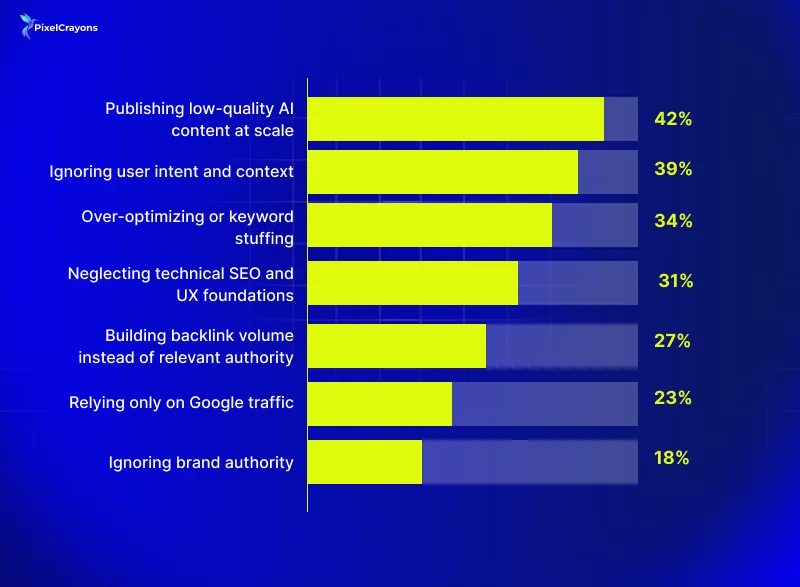
Search visibility today depends on more than just rankings and keyword optimization. Here are some common SEO mistakes businesses should avoid to stay competitive in modern search.
- Publishing low-quality AI content at scale
- Ignoring user intent and context
- Over-optimizing or keyword stuffing
- Neglecting technical SEO and UX foundations`
- Building backlink volume instead of relevant authority
- Relying only on Google traffic
- Ignoring brand authority
- Prioritizing quantity over usefulness
The Future of SEO in the AI-Powered Search Landscape
Ranking on Google is no longer the finish line. Brands now need to earn trust, recognition, and relevance across AI-powered search experiences as well.
SEO is not disappearing; it is evolving. Search engines are becoming better at identifying:
- Helpful content
- Trusted expertise
- Genuine authority
- Positive user experiences
AI is not replacing SEO but simply raising the bar for what earns visibility. In the AI search era, visibility will belong to brands that create real value, build authority, and stay relevant as search evolves.
Also Read: Best AI Dеvеlopmеnt & Consulting Companiеs
Wrapping Up
AI-powered search is significantly reshaping how users discover and consume information online. Traditional SEO tactics are not sufficient to maintain visibility and gain traffic in this rapidly evolving digital landscape. Adopting a structured, intent-driven approach plays a critical role in building long-term digital credibility.
This is where partnering with a provider offering AI & automation consulting services and advanced SEO expertise like PixelCrayons can make a difference. At PixelCrayons, we build custom AI search optimization strategies designed to future-proof your brand’s discoverability and build a strong presence in the next generation of search.
Ready to unlock growth? PixelCrayons offers white-label SEO services for agencies and brands, helping them get found on Google, voice search & AI platforms.
FAQS
1. Is SEO dead because of AI search?
Ans. No. SEO is evolving, not disappearing. Rankings still matter, but AI visibility, authority, and citations are becoming equally important.
2. What are zero-click searches?
Ans. Zero-click searches happen when users get answers directly on the search results page without visiting a website.
3. How can websites appear in AI-generated answers?
Ans. Websites improve their chances by publishing structured, trustworthy, well-organized content with clear answers and strong topical authority.
4. Does Google AI Overview reduce website traffic?
Ans. Yes, many websites are seeing lower click-through rates because users often get answers directly inside AI summaries.
5. What should businesses focus on for SEO in 2026?
Ans. SEO for AI search should focus on:
- Topical authority
- Brand visibility
- Structured content
- Technical SEO
- E-E-A-T
- AI citation optimization
- Multi-format content distribution

AI, SaaS & Digital Experience Strategist
Emma Joseph is a B2B writer and digital strategist with 7+ years of experience in the field of AI, SaaS, web development, eCommerce, UX, CRO, and digital marketing. Her work examines how emerging technologies and data-driven marketing enable organizations to accelerate growth.
Her expertise spans AI adoption, SaaS growth, website optimization, UX strategy, conversion optimization, and digital marketing. She focuses on translating complex technical concepts into practical business insights, enabling decision-makers to evaluate technologies, optimize digital experiences, and make informed investment decisions.
At PixelCrayons, Emma develops research-driven content for startup founders, business leaders, CMOs, CTOs, product teams, eCommerce brands, and digital agencies. Her writings cover AI, modern web technologies, performance marketing, and scalable growth strategies, with an emphasis on practical implementation and measurable business outcomes.
Emma’s writing reflects an execution-first perspective, combining technical depth with commercial relevance. She is committed to producing accurate, evidence-based content that helps organizations navigate digital transformation, improve customer experiences, and build sustainable growth through technology.
Let’s Connect Linkedin | Facebook
#WhiteLabelServices #BlockchainDevelopment #AIIntegration #Web3 #MachineLearning #DeFi #SmartContracts #AgencyGrowth #EmergingTechnologies