A founder’s guide to building the right engineering setup at the early stage
Choosing between outsourcing vs in-house development for startups is a strategic decision rather than merely an operational move. As per Deloitte’s Global Outsourcing Survey 2024, around 77% of organizations outsource IT infrastructure services and cybersecurity. While many businesses prefer in-house development, they often overlook the higher overhead costs that sometimes may exceed their profit margins.
Although both models can deliver outcomes, their efficacy depends heavily on your budget, scope, and project requirements.
- If you make the right choice, it will help your business gain momentum.
- If you choose the wrong path, you may spend months fixing avoidable problems.
This guide will help you decide which execution model is suitable for your business with more clarity.
Table of Contents
The Founder’s Problem: Why This Decision Is So Difficult
At an early stage, every startup founder is excited to:
- Launch fast
- Cut overhead costs
- Build something scalable
- Avoid technical debt
However, here’s a catch: you can’t optimize everything at once.
- In-house startup tech team structure may feel like control
- Outsourcing may feel like speeding up
This leaves startup founders with a common dilemma: hire in-house or outsource to a trusted white-label agency.
Common Paths Founders Take
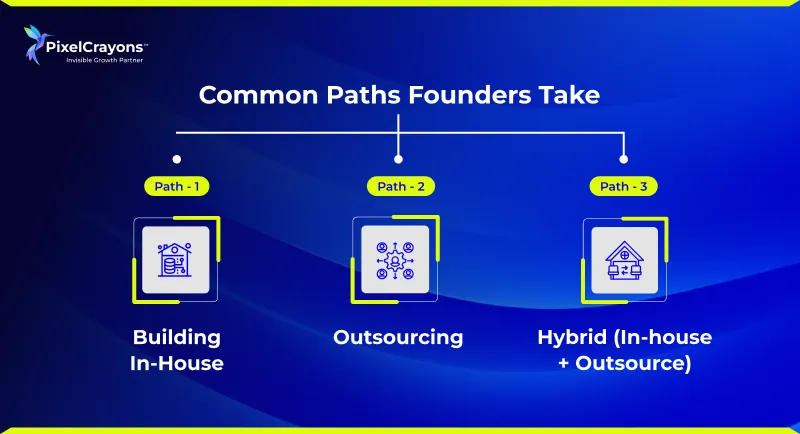
Let’s explore the common paths most startup founders take when it comes to building and scaling their product teams. Each approach offers a different balance of cost, speed, control, and scalability, and understanding these choices helps set the right foundation for sustainable product growth.
Path 1: Building In-House from Day One
This path follows a “build it internally” approach.
Startups set up their own teams of developers and designers, and often a technical lead or CTO, to develop the product in-house.
The team works within the organization, follows internal workflows, and stays closely aligned with business goals and stakeholders.
In-House Development: What You Gain?
- In-house development provides complete control over operation and resources. It is easy to conduct daily stand-ups, share immediate feedback, and offer hands-on management with an internal team.
- It is more convenient for team members to share their ideas and collaborate effectively in real time.
- In-house team members are usually more aligned with the company’s culture. Their deep institutional knowledge helps them resolve issues quickly.
- Handling projects in-house allows businesses to have stronger control over intellectual properties. Since all work is managed within organisations, there is less risk of IP theft or misuse.
In-house development may offer a fair share of benefits, but it also brings many setbacks, particularly for early-stage startups. Building an in-house team requires a high upfront investment in hiring, training, and retention. This may not align with the limited budget that many startups have. Moreover, dependence on core team members increases risk during employee turnover.
Also Read: How Software Outsourcing Overcomes Development Bottlenecks?
Path 2: Outsourcing to Move Fast
Most startups lean toward outsourcing often through a white-label partner because it gives them a fast, low-risk way to build and launch. Instead of spending months hiring and setting up an in-house team, they immediately get access to ready-to-deploy resources, pluggable development pods, and well-structured workflows.
Outsourced development: what do you gain?
Outsourcing gives you access to skilled developers at a significantly lower cost. When you hire developers from an outsourcing partner, it can be 30–60% more cost-effective than building an in-house team. It also gives you the liberty to hire talent based on specific project needs.
- Ready-to-deploy teams remove delays caused by hiring and onboarding cycles. This ensures faster project kickoff and execution.
- Established workflows and tested tools help deliver projects on time with greater efficiency. It reduces execution risks and improves consistency.
- Access to diverse technical expertise and industry experience strengthens product quality. It removes the need to build a full in-house specialist team.
- Resources can be scaled up or down easily based on project demands. This gives you more flexibility without long-term hiring commitments.
- Founders can focus on growth, strategy, and customers while execution is managed externally. White-label partners ensure smooth scaling without adding internal workload.
Outsourcing can sometimes raise concerns around workflow alignment and data security when working with external teams. However, experienced outsourcing partners address these challenges through structured processes, strict quality standards, and strong security protocols, including NDAs and compliance practices.

Power your growth with expert white-label design, marketing, and development, built for efficiency and seamless delivery.
Path 3: The Hybrid Approach: Integrating In-House & Outsourcing Models
Many successful start-ups follow a hybrid development approach. They retain strategic positions at home and outsource heavy work execution. In other words, it is not about choosing one of them; it is about embracing both in a balanced way based upon your organisational needs.
A hybrid model combines:
- An in-house team for strategy and ownership
- An external team for execution and scaling
This ensures
- Core engineering stays in-house
- Outsourcing used for execution-heavy or non-core tasks
- Example: backend in-house, UI or QA outsourced
- Balances speed with long-term ownership
This helps create a more productive work environment, allowing startup founders to:
- Stay lean while building
- Launch faster without overhiring
- Maintain control over core decisions
- Scale efficiently without burning cash
The Reality Check: In-House vs Hybrid vs Outsourcing for Startups
|
Factor |
In-house Development |
Outsourcing Development |
Hybrid Approach |
|
Initial Cost |
High due to expensive salaries, hiring, and benefits |
Lower and more predictable cost |
Balanced—core team in-house, execution partially outsourced |
|
Hiring Time |
Slow and uncertain often takes months |
Instant access to ready-to-deploy teams |
Faster than in-house, slower than pure outsourcing |
|
Speed to market |
Slower in the early stages |
Fast MVP and Feature Delivery |
Fast, with in-house direction + external execution |
|
Flexibility |
Difficult to scale up and down quickly |
Easy to scale based on project needs |
Moderate flexibility with controlled scaling |
|
Expertise range |
Limited to hired skilled sets |
Access to multiple global specialists |
Combination of internal knowledge + external expertise |
|
Management effort |
Require internal leadership and HR Involvement |
Managed processes with minimal founder involvement |
Shared responsibility between internal and external teams |
|
Product Understanding |
Deep long-term understanding |
Strong understanding if partner has start-up expertise |
High—core vision stays in-house, execution supported externally |
|
Risk Factor |
High fixed cost risk |
Lower financial and operational risks |
Medium risk with balanced dependency |
Why High-Growth Startups Are Turning to Outsourcing?
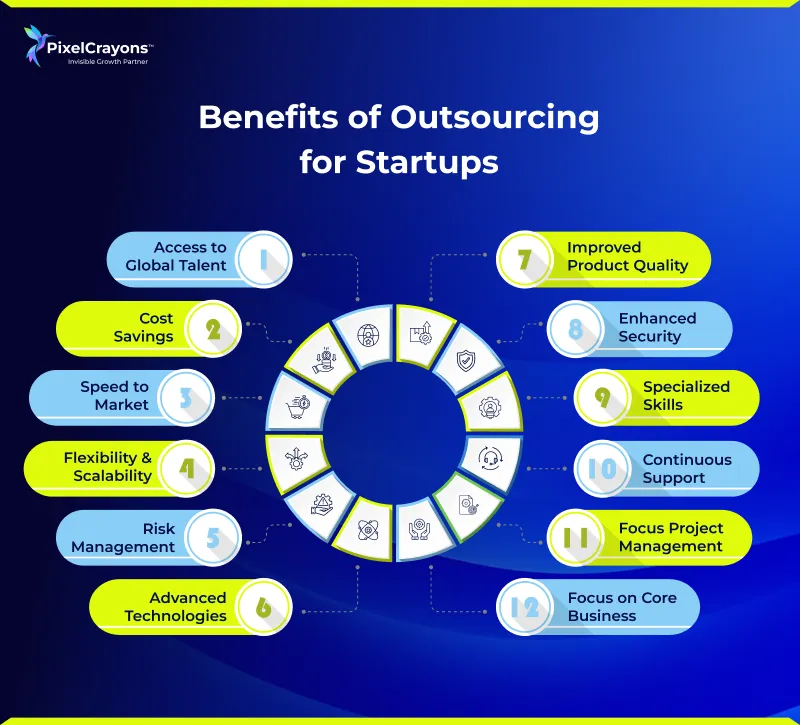
Many startups choose to outsource custom software development or even use white-label web development services to scale their capabilities without increasing in-house headcount. This approach is more common amongst early-stage startups for several key reasons:
Reduced Financial Burden
Growing and scaling a startup requires financial resources, and there is no doubt that outsourcing can reduce operating costs. This is particularly true when you hire a reliable white-label partner like PixelCrayons. Easing financial pressures is a great boost for any emerging startup.
Instant Infrastructure
Outsourcing gives startups immediate access to talent, tools, and systems without heavy setup costs. It removes the burden of building teams and infrastructure for less critical business functions, allowing founders to stay focused on growth.
Expert Guidance & Corporate Insight
Experienced outsourcing partners bring industry knowledge that helps startups avoid biased decisions and operational blind spots. They offer practical insights on workload, priorities, and realistic execution based on domain expertise.
Avoiding Burnout & Sustaining Growth
Startups often operate under high pressure, which can quickly lead to burnout. Outsourcing helps distribute workload efficiently, giving founders and teams the bandwidth to stay productive, focused, and consistent in scaling the business.
Thinking Out of the Box
Thinking out of the box is crucial to grow and succeed in the competitive business environment. While some startup founders may not put their trust in outsiders, there are many who have achieved profound success through partnering with the right software company.
It helps realise their full potential to deliver rapid growth. Discover how the right IT outsourcing partner can boost your business; Read more in our latest blog.
Compare outsourcing vs. in-house development for startups and scale with confidence.
PixelCrayons – Your Trusted White Label Partner
Looking for a partner you can truly rely on to bring your ideas to life? We are a trusted white-label partner, dedicated to helping startups scale faster and smarter. From innovative design and strategic marketing to robust development solutions, we work behind the scenes so you can shine in front of your clients. Our team blends creativity with technical expertise to deliver results that not only meet expectations but exceed them. At PixelCrayons, we help startups:
- Launch MVPs in 6-12 weeks
- Build secure, scalable architecture
- Set up CI/CD and multi-device support
- Act as interim CTOs or strategic advisors
- Ensure seamless transition to internal teams
Wrapping UP
Choosing between outsourcing and an in-house team is one of the most critical decisions for start-ups. Selecting the right path requires that you carefully assess your project needs and map them with the KPIs associated with each model. Early-stage startups usually prefer outsourcing because it enables fast, flexible, and cost-effective execution. Many successful organisations blend both models to maximize impact. It is prudent to look for a reliable and experienced outsourcing IT partner so you can focus on sales, strategy, and growth, while your partner will take care of development and delivery.
Fuel Your Startup Growth with Scalable Outsourced Development Today. Contact us for more details.
Frequently Asked Questions
1. Outsourcing vs in-house development for startups: which is better?
Ans. Choosing between outsourcing and in-house depends upon many factors. Outsourcing development is usually considered a viable option for start-ups, especially those at an early stage. It provides faster development at lower prices.
2. What are the benefits of outsourcing vs in-house development?
Ans. Outsourcing development offers faster execution, lower upfront costs, and access to global talent. The in-house model provides better supervision and control. When you choose the right outsourcing partner, they provide the best of both worlds, combining the in-house and outsourcing development.
3. What is the cost of outsourcing software development?
Ans. The cost of outsourcing software development varies depending on factors like region, complexity, and expertise. However, outsourcing is generally more cost-effective for early-stage startups.
4. What is the best development approach for startups?
Ans. Many start-ups adopt a hybrid model, keeping core work in-house and outsourcing specialized or short-term tasks. This approach, which combines the in-house strategy with outsourced execution, is often the most effective. It is prudent to look for an experienced and expert outsourcing partner to get the best outcomes.