Ever wondered why some businesses struggle to scale smoothly even after investing heavily in modern software tools and automation platforms? This is the reality for many growing businesses managing multiple workflows built on disconnected business tools.
As operations expand, management becomes increasingly complex.
- Campaign data lives across multiple platforms
- CRMs fail to synchronise properly
- Reporting numbers conflict
As a result, teams spend their valuable time handling manual processes. They get less time focusing on strategy and growth.
Over time, these disconnected tools create friction. It slows operations, reduces productivity, and makes scaling increasingly challenging.
Most organizations nowadays have access to the best data engineering tools and technology to support growth. However, the real problem is that these systems often fail to work together effectively.
This is why more companies are shifting their focus from simply adding new technology to building connected operational systems. These systems help in improving visibility and workflow efficiency.
Why Disconnected Systems Create Operational Friction
Most companies adopt software to solve specific operational problems.
CRM systems manage customer relationships. Reporting platforms improve visibility. Workflow automation tools reduce repetitive work. Collaboration systems improve communication.
Individually, these tools may deliver clear value. But the real problem begins when these tools fail to coordinate with each other. This leads to fragmented information across multiple platforms instead of operating through a unified workflow.
At a smaller scale, this doesn’t feel critical. But as workflows expand, these gaps turn into serious tool integration challenges.
Common operational issues include:
- Re-entering the same information across multiple tools
- Switching between applications to complete workflows
- Reconciling conflicting reports
- Delays due to manual approvals and updates
- Broken automation flows
What starts as a minor inefficiency slowly becomes a scalability issue.
Connect Your Business. Scale Without Friction.
Replace disconnected business tools with a unified platform.
Also Read: 10 Best Workflow Automation Companies in 2026
The Operational Impact of Fragmented Systems
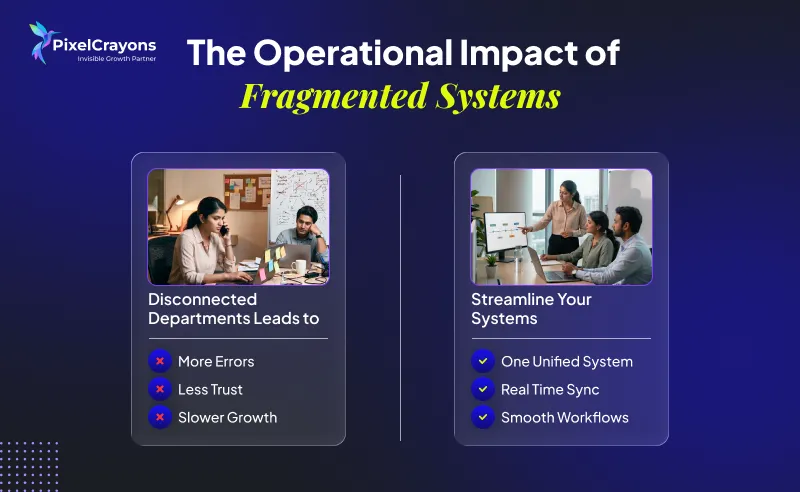
The impact of disconnected business tools goes far beyond inefficiency.
It directly affects the way teamwork and decisions are taken, and also how confidently businesses rely on their data.
Teams deal with fragmented and inconsistent information rather than unified insights.
This leads to:
Conflicting reporting
Duplicate work across departments
Manual reconciliation of data
Slower decision-making
Reduced trust in operational metrics
For example, marketing teams using different systems from sales often end up with mismatched performance data. This makes evaluation difficult and slows decision-making. According to Quickbase, nearly 70% of employees spend over 20 hours each week managing information spread across disconnected systems and tools.
This is why many organizations are now adopting integrated operational systems. These connected systems help simplify workflows and improve cross-functional visibility.
Why Growth Amplifies the Problem
When a business grows, it naturally increases complexity.
More customers, more workflows, more tools, and more integrations all add pressure on existing systems.
Disconnected tools don’t just slow operations; they multiply inefficiencies.SMOOTH workflows
A typical growing organization ends up using:
- CRM platforms
- Analytics dashboards
- Automation tools
- Customer support systems
- Project management tools
- Third-party integrations
Individually, they may work fine. But together, maintaining consistency becomes difficult.
As a result, companies face:
- Delayed updates across systems
- Broken automation workflows
- Inconsistent customer data
- Manual onboarding processes
- Reduced visibility across teams
At this stage, companies start looking for the best ways to integrate business tools for reducing friction and restoring operational flow. As creating a connected system is not a straightforward process, many organizations seek support from white-label agencies. These agencies are equipped with expertise to help businesses build scalable ecosystems.
Common Tool Integration Challenges
As businesses try to solve fragmentation, they quickly realize integration is not simple.
Most platforms are designed to operate independently, making seamless synchronization difficult without APIs, middleware, or custom integration frameworks
This leads to ongoing tool integration challenges, such as:
Inconsistent Data Synchronization
Data fails to update across systems in real time, creating mismatches.
Reporting Discrepancies
Different tools calculate metrics differently, confusing reporting.
Manual Workarounds
Teams rely on spreadsheets and exports to connect systems.
Integration Maintenance
Updates in one system often break existing workflows.
Limited Automation Scope
Automation remains isolated within tools instead of working across the entire system.
Without a clear strategy, complexity keeps increasing in the background. In many cases, partnering with a custom software development company helps businesses overcome integration limitations and create systems tailored to their operational requirements.
Also Read: Top 16 Custom Software Development Companies in 2026
Simplify Your Systems. Scale Your Operations
Solve tool integration challenges with smarter workflows and scalable support built for growing businesses and agencies.
Why Adding More Tools Doesn’t Solve the Problem
When operations become inefficient, the natural reaction is to add more tools.
But in reality, this often increases fragmentation instead of solving it.
Every new tool adds:
- Another data source
- Another workflow layer
- Another integration dependency
- Another maintenance burden
Instead of fixing disconnected business tools, many organizations unintentionally end up expanding them.
Long-term efficiency comes from system integration and tech stack optimization, and not expanding the stack endlessly.
The focus shifts toward:
- Reliable data synchronization
- Centralized reporting
- Workflow automation
- Cross-platform visibility
- Unified operational processes
When systems are connected properly, teams spend less time managing tools and more time executing work.
Technology Is Moving Toward Connected Ecosystems
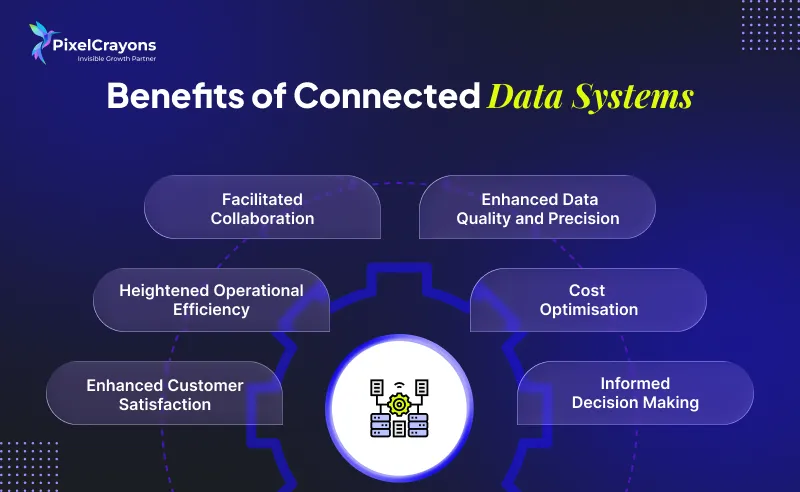
Technology trends are clearly shifting away from isolated tools toward integrated ecosystems.
Cloud platforms, AI-driven systems, and unified infrastructures are redefining how businesses operate.
Instead of standalone tools, the future is about systems working together seamlessly.
Organizations that invest early in connected systems gain:
- Better visibility
- Faster execution
- More reliable data
- Easier scalability
This shift is especially important for companies managing complex, disconnected business tools across departments.
Build Connected Ecosystems That Scale
Turn disconnected business tools into streamlined, scalable workflows.
What Businesses Should Focus On Next
The next stage of operational maturity is not about adding more software.
It’s about asking better questions:
- Are our systems truly connected or just coexisting?
- Can teams access reliable data quickly?
- Are we spending more time executing or managing tools?
- Do we have the expertise needed to build scalable, integrated systems internally?
- Would partnering with experienced integration teams help accelerate operational scalability?
When these questions are answered by businesses thoughtfully, gaps become very clear.
The goal is not just adding tools; it is building connected systems that eliminate fragmentation.
Conclusion
Operational complexity often appears gradually. As organizations adopt more tools, workflows, automations, and disconnected systems, it increases complexity. This, in turn, leads to operational inefficiencies.
In the beginning, these inefficiencies seem trivial. However, over time, they lead to reporting inconsistencies, workflow bottlenecks, increased manual work, and reduced visibility.
Organizations adopting simple infrastructure and connected systems are far more likely to scale efficiently than those that rely on fragmented systems. This is one reason why demand for digital transformation services continues to grow as organizations modernize operations and improve system connectivity.
This is where companies like PixelCrayons help agencies replace disconnected tools and fragmented workflows and replace them with a fully integrated execution team operating under their brand. When agencies adopt an integrated system model, they no longer need to manage multiple vendors, internal bottlenecks, and scattered campaign processes; instead, they gain a streamlined delivery structure. This connected and scalable operating model reduces operational friction. It also improves consistency and helps agencies grow efficiently without constantly expanding internal overhead.
FAQS
1. What are disconnected business tools?
Ans. Disconnected business tools are platforms that operate independently without sharing data, workflows, and operational processes. This often leads to increased manual work, data and reporting inconsistencies, and operational delays.
2. Why do disconnected systems become a bigger problem as operations scale?
Ans. As the operation scale increases, disconnected systems become bigger problems for businesses. As teams and workflows grow, these disconnected systems create more chaos and complexity. Small inefficiencies quickly lead to turning into operational bottlenecks that slow execution and reduce visibility.
3. Why do business tools fail to integrate properly?
Ans. Most platforms are built independently with different APIs, data structures, and workflows. Without a proper integration strategy, systems strive to synchronize reliably and often require manual workarounds.
5. What is the best way to integrate business tools?
Ans. The best way to integrate business tools is through connected workflows, automation, centralized reporting, and reliable data synchronization. As operations grow, many teams also work with white-label marketing partners for agencies. These independent agencies help organizations improve system connectivity and reduce operational complexity.
6. How can white-label marketing partners help reduce operational complexity?
Ans. As operations scale, it becomes challenging to manage multiple platforms, report systems, and workflows internally. Working with white-label marketing partners for agencies can help streamline execution and reduce the operational burden without expanding internal teams. Key benefits of hiring white-label agencies are the following:
- Brand-Invisible Execution
- Flexible Capacity
- Access to Specialists
- Predictable Delivery
- Consistent quality
7. When should a business hire API developers?
Ans. Businesses should consider hiring API developers when multiple platforms need to exchange data reliably, custom integrations are required, or existing workflows rely heavily on manual processes. Experienced API developers can help improve system connectivity, automate workflows, and reduce operational inefficiencies.

Transforming the Future with White Label Blockchain and AI
I’m a White Label Blockchain & AI Expert with 7+ years of experience, partnering with digital agencies and consulting firms to deliver white-label blockchain, AI, and Web3 solutions for their clients. I work behind the scenes to help agencies scale faster, expand service offerings, and deliver secure, future-ready solutions—under their own brand.
What I Offer to Agencies
White-Label Blockchain Solutions
- End-to-end development of smart contracts, DApps, and enterprise-grade blockchain systems using Ethereum, Hyperledger, Solana, and more.
- Hands-on experience with DeFi platforms, NFT ecosystems, and Web3 infrastructure—delivered seamlessly as your in-house capability.
White-Label AI Integration
- Designing and deploying machine learning models for predictive analytics, automation, and operational efficiency.
- Implementing NLP and AI-powered solutions for intelligent, data-driven decision-making.
- Combining AI with blockchain to build secure, decentralized, and scalable applications for client use cases.
Scalable Innovation for Client Projects
- Helping agencies deliver advanced solutions for identity management, traceability, security, and compliance by merging AI and blockchain technologies—without increasing internal overhead.
Your Trusted White-Label Tech Partner
I’m passionate about enabling agencies to win more projects, reduce delivery risk, and increase margins with reliable white-label Blockchain, AI, and Web3 development support. If you’re looking for a long-term technical partner to strengthen your offerings, let’s collaborate and build impactful solutions—together.
Let’s Connect Linkedin | Facebook
#WhiteLabelServices #BlockchainDevelopment #AIIntegration #Web3 #MachineLearning #DeFi #SmartContracts #AgencyGrowth #EmergingTechnologies
Tags:


