AI marketing automation and traditional automation are distinct capabilities that require different strategies. Confusing them wastes resources and opportunities.
When you properly understand both technologies and partner with experienced providers who can implement them, you move beyond chasing efficiency to actually achieving it.
Core Difference Between AI and Automation
Traditional automation functions like a predetermined sequence. Once initiated, each step executes identically every time.
For example: A prospect completes a form → the system immediately sends a confirmation email → adds the contact to your newsletter database → schedules a follow-up message for day three. The sequence never varies.
AI marketing automation learns from accumulated data.
For example: The system analyzes user behavior: “Prospects from Instagram respond better to video content. Prospects from Google search convert more frequently with discount offers.”→ determines appropriate email content for each segment → evaluates which approach performed better → increases deployment of the successful strategy going forward.
Quick Reference Comparison
|
Capability
|
Traditional Automation
|
AI Marketing Automation
|
|
Decision-making
|
No. Executes predetermined rules only
|
Yes. Learns from data and adjusts behavior
|
|
Adaptability
|
Requires manual rule modification
|
Self-adjusts based on performance data
|
|
Optimal use cases
|
Repetitive tasks: welcome sequences, lead tagging, social posting
|
Personalization, prediction, content generation, campaign optimization
|
|
Human involvement
|
Configure logic once during setup
|
Periodic training, review, and course correction
|
|
Practical example
|
“If the lead score exceeds 50, assign it to the sales team.”
|
“Predict which leads will close within seven days and send targeted offers.”
|
Automation executes a fixed checklist. AI learns from the checklist and refines it over time.
Your business needs both technologies, but success requires understanding which tool suits each specific task.
Stop Guessing Between AI and Automation
Get a clear roadmap for what to automate vs what to AI-enable in your business.
Why Organizations Struggle Despite Investing in Quality Tools
The following pattern repeats across agencies and brands:
They purchase enterprise platforms like HubSpot, Marketo, or ActiveCampaign. They activate workflow automation, and emails are now sent automatically, and integrate AI tools for marketing automation to generate subject lines. Then reality sets in:
- AI doesn’t properly integrate with the existing CRM
- Automation rules remain simplistic (“send identical message to entire list”)
- No internal bandwidth exists to build sophisticated logic
- They hire freelancers, yet tools remain partially connected
Real Capabilities of AI Marketing Automation
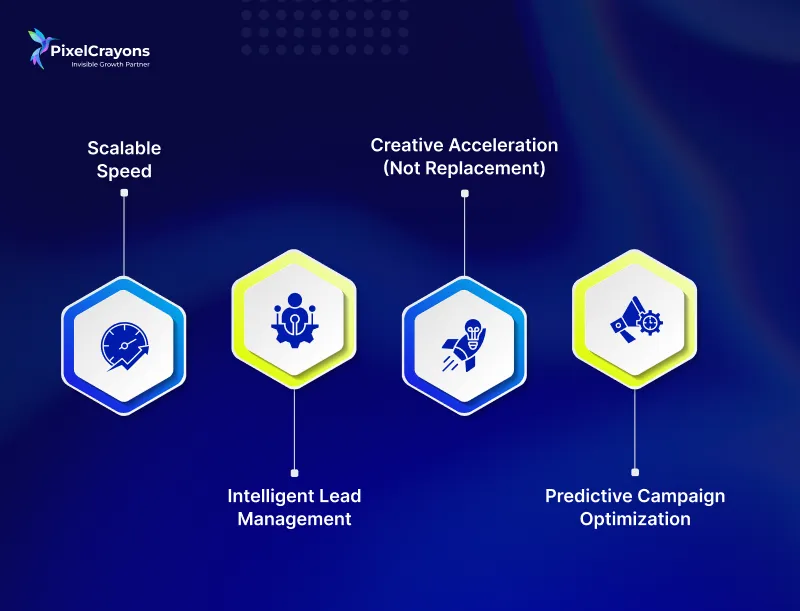
When AI and automation integrate properly, you gain specific advantages:
1. Scalable Speed
AI can generate up to 500 advertisement headlines in seconds. It can segment 100,000 customers by predicted lifetime value overnight. Above all, it can personalize every email, SMS, and push notification without manual intervention.
2. Intelligent Lead Management
Traditional automation moves leads through pipeline stages. AI marketing automation adds another layer: it scores leads based on behavioral data, company characteristics, and historical conversion patterns. Sales teams engage only with genuinely qualified prospects, demonstrating practical applications of how AI is replacing marketing workflows.
3. Creative Acceleration (Not Replacement)
AI generates three Facebook ad concepts. A human designer selects one and refines it in five minutes rather than two hours.
4. Predictive Campaign Optimization
AI tests twenty subject lines on 5% of your email list, automatically sends the top performer to the remaining 95%, and requires no human involvement after initial setup. These represent the top AI tools to automate marketing in 2026, delivering measurable efficiency gains.
However, AI excels only at executing previously observed patterns. It struggles with entirely novel scenarios, cultural nuance, and emotional intelligence.
Also Read: 5 Ways Non-profits Are Using AI to Make an Impact
Move From AI Experiments to AI Systems That Perform
We don’t just recommend tools. We build working automation ecosystems.
Understanding AI Limitations
You cannot implement AI marketing automation on a “set and forget” basis.
|
AI/Automation Limitation
|
Real-World Consequence
|
|
Lacks contextual judgment
|
AI once suggested “You look great in nothing” for a swimwear brand, technically accurate but commercially disastrous.
|
|
Perpetuates data bias
|
If historical campaigns exclusively targeted men, AI continues to ignore women.
|
|
Cannot explain reasoning
|
AI identifies that an email achieved higher open rates, but cannot determine if it succeeded because the humor matched the day’s weather.
|
|
Integration challenges
|
Your email AI doesn’t communicate with advertising AI. Your advertising AI doesn’t connect with your CRM.
|
|
Privacy concerns
|
AI personalization can feel invasive (“How does this company know my situation?”).
|
Success requires human oversight for strategy, brand consistency, and ethical boundaries. Also, you need technical partners capable of building integrations between disparate systems.
This is where specialized white label AI automation services become valuable. Most companies give you advice. PixelCrayons gives you a working system.
Our AI workflow automation services operate across three essential domains:
- Marketing: Audit existing workflows, identify highest-impact automation opportunities, then integrate tools (HubSpot, Marketo, custom chatbots) or build proprietary solutions to automate marketing workflows with AI.
- Design: Use AI-assisted platforms (Midjourney, DALL-E, Adobe Firefly) to generate draft creative assets. Human designers refine output. Alternatively, build custom AI image pipelines matching your brand guidelines.
- Development: Write integration code connecting all systems; CRMs, ERPs, eCommerce platforms, legacy databases. Build predictive models for churn probability, lifetime value, and next-best-action recommendations.
Rather than delivering reports and departing, we build, test, and give live automated workflows.
AI Marketing Automation In Practice
Here is how comprehensive AI marketing automation works in practice.
Client scenario: A mid-sized pet food brand selling allergy-sensitive dog food
Objective: Recover abandoned carts and increase repeat purchases
Starting point: Generic “You forgot something” emails recovering 5% of abandoned carts
Phase 1: Strategic Analysis
The implementation team analyzes existing data:
- 70% of cart abandoners browse for more than two minutes but exit at the shipping page
- Previous buyers of “grain-free” products have 3x higher lifetime value
- Instagram traffic converts better with video content; Google traffic responds better to discount codes
Identified needs:
- AI that personalizes recovery offers based on traffic source and browsing history
- Automation triggering at optimal times (not just one hour post-abandonment)
- Design automation generating dynamic email banners
Phase 2: Build and Integration
The team constructs a custom workflow for AI automation in digital marketing:
Data infrastructure: Connects Shopify + Google Analytics + HubSpot into one event stream
AI decision engine: A targeted model scoring each abandoned cart on:
- Price sensitivity (derived from purchase history)
- Content preference (video vs. discount vs. testimonial)
Automation triggers:
- Score above 80 → send SMS + email within 15 minutes
- Score 50-80 → email only after 2 hours
- Score below 50 → wait 24 hours, then send alternative email
Design automation: For each user, AI retrieves the cart product image, adds dynamic text (“Your [product name] is waiting”), and renders three variants
Delivery systems: Integrated with Twilio for SMS and SendGrid for email
Also Read: How to Power Your SEO Content With AI
Phase 3: Human Oversight Layer
The team establishes a dashboard to approve or reject any AI-generated content falling outside brand guidelines. They also install a “safety switch,” which, if open rates drop below 5%, the workflow pauses and alerts team members.
Phase 4: Measured Results
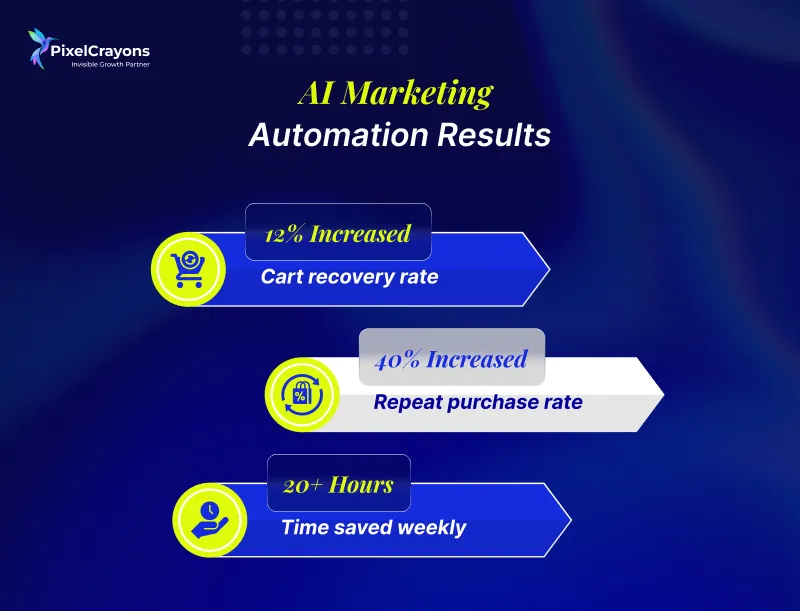
- Cart recovery rate: 17% (increased from 5%)
- Repeat purchase rate: increased 40% because AI learned optimal timing for refill reminders
- Time saved weekly: 20+ hours for the brand’s marketing team
Ready to Turn Automation Into Revenue?
Stop experimenting. Start implementing systems that actually scale.
AI’s Impact on Marketing Roles: What Actually Changes
If your team’s primary function involves sending identical emails to entire lists and manually transcribing numbers into reports, yes, AI and automation will replace those activities.
What remains irreplaceable:
- Strategic thinking, understanding brand identity, and market positioning
- Creative breakthroughs (the “Share a Coke” concept, not the hundredth “Don’t miss out” subject line)
- Emotional and cultural judgment (pausing campaigns due to tone-deaf messaging after news events)
- Ethical decision-making (refusing to exploit vulnerable customer segments)
The emerging competitive advantage: Marketers who can direct AI systems and design automated workflows. Agencies offering “AI-augmented services” will win clients from slower competitors.
Achieving this requires technical execution capability, professionals who can integrate AI with CRMs, build dynamic email templates, and configure decision logic. This explains the growing demand for AI consulting services for agencies that understand both marketing strategy and technical implementation.
Also Read: Can AI Fully Replace Digital Marketing Teams by 2030?
Getting Started: From Concepts to Functioning Systems
You now understand the fundamental concepts, have seen complete workflows, and recognize the limitations. Your next requirement: partners who don’t merely discuss AI automation in digital marketing but actually build, integrate, and maintain systems.
PixelCrayons does exactly that.
- Identify: Specialists locate your most significant time-draining activities and revenue leaks.
- Execute: They build custom solutions spanning marketing, design, and development.
- Deliver: You receive a live, learning system.
Whether you need white label robotic automation services for client delivery or AI-powered virtual assistant services for internal operations, reach out to PixelCrayons for AI workflow automation services.
Start with one workflow. Measure the results. Then scale what works. That’s how you build marketing automation for conversions that actually deliver on the promise of efficiency without sacrificing quality or brand consistency.
Frequently Asked Questions (FAQs)
1. What is AI marketing automation?
Ans. AI marketing automation uses artificial intelligence to automate, personalize, and optimize marketing workflows based on customer behavior and performance data. Unlike traditional automation, it learns from interactions and improves campaigns over time.
2. How is AI replacing marketing workflows?
Ans. AI is replacing marketing workflows that involve repetitive manual tasks such as customer segmentation, reporting, email personalization, lead qualification, and campaign optimization. Modern AI tools for marketing automation can analyze data in real time, predict customer intent, and automate decisions faster than manual processes.
3. What are the benefits of AI automation in digital marketing?
Ans. AI automation in digital marketing helps businesses:
- Personalize campaigns at scale
- Improve lead quality with predictive scoring
- Automate repetitive marketing tasks
- Optimize campaigns using performance data
- Increase conversions and customer engagement
4. Which are the top AI tools to automate your marketing in 2026?
Ans. Some of the top AI tools to automate your marketing in 2026 include:
- HubSpot
- Marketo
- Salesforce Einstein
- ChatGPT
- Adobe Firefly
- Midjourney
- ActiveCampaign
PixelCrayons provides AI consulting services for agencies and businesses to implement, customize, and optimize these tools for measurable growth.
5. How can businesses automate marketing workflows with AI?
Ans. Businesses can automate marketing workflows with AI by:
- Identifying repetitive marketing tasks
- Integrating AI tools with CRM and analytics platforms
- Using predictive models for targeting and personalization
- Automating campaign triggers and customer communication
- Continuously optimizing workflows based on performance
PixelCrayons delivers AI workflow automation services, white label AI automation services, and AI-powered virtual assistant services to help businesses build scalable automated systems.
6. Why are white label AI automation services growing?
Ans. White label AI automation services help agencies offer AI-powered marketing solutions without building large in-house technical teams. Agencies can provide automation, AI integrations, reporting systems, and predictive marketing capabilities under their own brand. Partnering with PixelCrayons provides agencies with white label robotic automation services, custom AI development, and end-to-end implementation support.

Transforming the Future with White Label Blockchain and AI
I’m a White Label Blockchain & AI Expert with 7+ years of experience, partnering with digital agencies and consulting firms to deliver white-label blockchain, AI, and Web3 solutions for their clients. I work behind the scenes to help agencies scale faster, expand service offerings, and deliver secure, future-ready solutions—under their own brand.
What I Offer to Agencies
White-Label Blockchain Solutions
- End-to-end development of smart contracts, DApps, and enterprise-grade blockchain systems using Ethereum, Hyperledger, Solana, and more.
- Hands-on experience with DeFi platforms, NFT ecosystems, and Web3 infrastructure—delivered seamlessly as your in-house capability.
White-Label AI Integration
- Designing and deploying machine learning models for predictive analytics, automation, and operational efficiency.
- Implementing NLP and AI-powered solutions for intelligent, data-driven decision-making.
- Combining AI with blockchain to build secure, decentralized, and scalable applications for client use cases.
Scalable Innovation for Client Projects
- Helping agencies deliver advanced solutions for identity management, traceability, security, and compliance by merging AI and blockchain technologies—without increasing internal overhead.
Your Trusted White-Label Tech Partner
I’m passionate about enabling agencies to win more projects, reduce delivery risk, and increase margins with reliable white-label Blockchain, AI, and Web3 development support. If you’re looking for a long-term technical partner to strengthen your offerings, let’s collaborate and build impactful solutions—together.
Let’s Connect Linkedin | Facebook
#WhiteLabelServices #BlockchainDevelopment #AIIntegration #Web3 #MachineLearning #DeFi #SmartContracts #AgencyGrowth #EmergingTechnologies