Peak season compresses months of opportunity into a few weeks. Every campaign, every price change, every promotional push has to land inside a window that doesn’t leave room for delays. It’s the moment when your eCommerce growth strategy is put to the real test.
Marketing drives that window. It brings in traffic, runs campaigns, and creates the demand. Development determines what happens next. It decides whether the store can handle that traffic, whether checkout holds up, and whether the site converts visitors into paying customers. This is where eCommerce marketing and development intersect, and where the real risk lies.
When these two functions sit with separate vendors, the handoff between them becomes a liability. Decisions slow down. Fixes get delayed. And a campaign that should have worked can fail miserably, not because the marketing was wrong, but because the site, the checkout, or the infrastructure wasn’t ready to support it.
The core issue isn’t marketing or development individually. It’s the gap between them. During peak season, that gap gets expensive.
Table of Contents
Why Peak Season Changes the Equation
Most of the year, a fragmented setup is survivable. A slow-loading page costs some conversions. A delayed integration gets fixed next sprint. The business absorbs it and moves on.
Peak season removes that cushion. Traffic spikes hard and fast. Campaign volume goes up. Promotional windows shrink to days or hours instead of weeks. Websites need more frequent changes, checkout and infrastructure carry more load, and customers expect everything to work without friction. In short, every fragile point in an eCommerce digital growth strategy gets tested at once.
At the same time, there’s less room to catch and fix problems. A technical issue that would be a minor inconvenience in March can turn into a significant revenue loss during a 48-hour flash sale. The margin for error shrinks exactly when the stakes go up.
Where Separate Vendors Create Problems
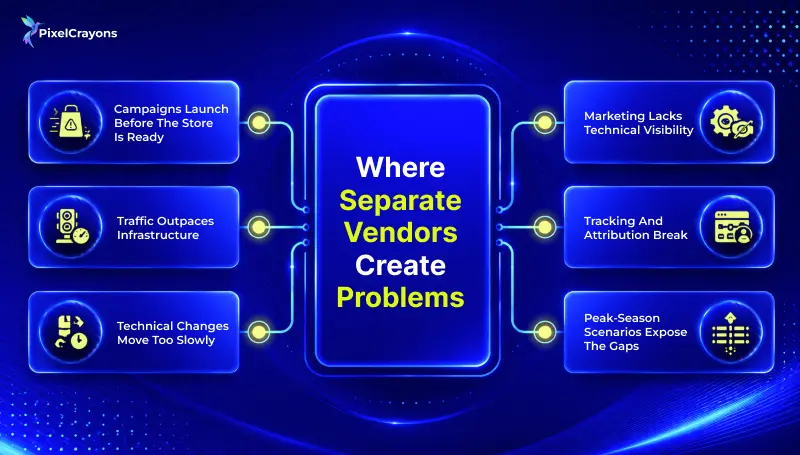
1. Campaigns Launch Before the Store Is Ready
Marketing builds a campaign around a launch date. Development gets the requirements late, often after the creative and messaging are already locked. Landing pages aren’t finished. Integrations aren’t tested. Promotional logic isn’t wired up correctly. The campaign goes live anyway, and performance takes the hit. This is a common failure pattern when eCommerce development services and marketing operate in silos. In fact, it’s just as common when eCommerce marketing services are managed independently of the technical roadmap.
2. Traffic Outpaces Infrastructure
Marketing does its job and drives a surge in visitors. But if nobody planned infrastructure capacity around that surge, the site slows down or breaks under load. The campaign worked; the website didn’t. Industry research puts the cost of peak-season downtime at roughly $540,000 per hour for medium and large-scale eCommerce sites, a number that turns a technical delay into a board-level problem.
3. Technical Changes Move Too Slowly
Campaigns need frequent, fast adjustments: a new banner, an updated offer, a tweaked landing page. When development works from a separate roadmap and ticketing queue, requests that should take hours turn into requests that take days. By the time the ships change, the promotional window has closed. A 2026 survey of 430 marketers found that 46% of teams cite slow approvals and bottlenecks as their top obstacle, often tracing back to dependency on departments like IT that move at a different pace.
4. Marketing Lacks Technical Visibility
Marketing tracks campaign performance and conversion rates. Development tracks site speed, uptime, and error logs. Neither side sees the full picture. So when revenue dips, both teams generally have half the answer.
5. Tracking and Attribution Break
New landing pages, promotional campaigns, analytics updates, and third-party integrations all touch tracking in some way. Without coordination, tags misfire, events stop recording, and attribution data becomes unreliable right when leadership needs it most.
6. Peak-Season Scenarios Expose the Gaps
Take Black Friday and Cyber Monday. Marketing plans aggressive discounting and heavy paid spend. Development needs to make sure checkout can handle concentrated traffic, and the promotional pricing logic works without errors. If coordination doesn’t happen, the business risks lost sales at the exact moment demand is highest.
The same pattern shows up with flash sales, product launches, limited-time offers, high-volume paid campaigns, and inventory-led promotions. In every case, a marketing requirement creates a development requirement, and a gap between the two becomes a revenue risk.
Also Read: Future-proofing Your eCommerce Business
What Marketing and Development Should Have In Common
Closing this gap starts with shared visibility. Effective eCommerce marketing and development don’t need to merge into one department, but they do need common ground on a few things.
- Revenue Targets: Both teams understand what a campaign is actually meant to achieve commercially, not just operationally.
- Campaign Calendar: Development knows what’s coming and when technical support will be needed, well before launch day.
- Traffic Forecasts: Expected demand feeds directly into infrastructure and performance planning.
- Promotional Roadmap: Discounts, bundles, and launches get reviewed from both a marketing angle and a technical one before they go live.
- Performance Data: Conversion rates, traffic, site speed, and campaign results sit in a shared view, not two separate dashboards, feeding directly into conversion rate optimization efforts.
- Technical Risks: Bottlenecks get flagged and addressed before a campaign launches, not after it underperforms.
Building a Peak-Season Growth Stack
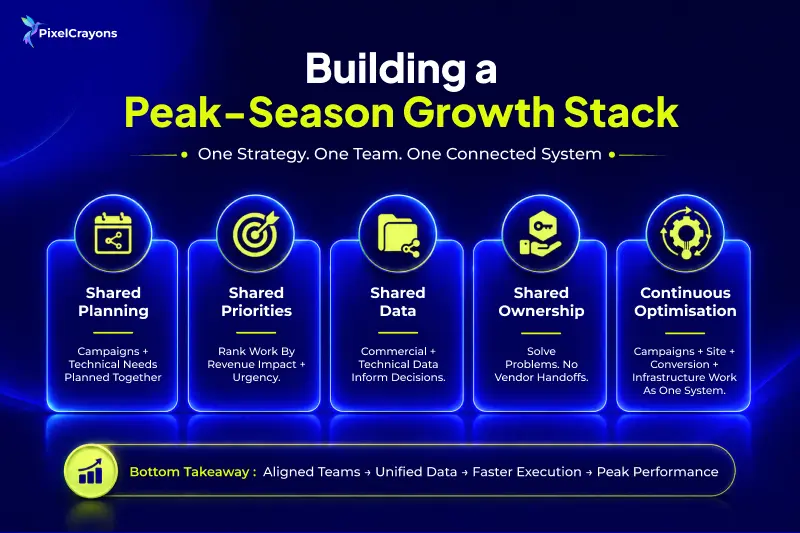
Once that shared visibility exists, it needs to translate into how work actually gets done, the true test of any eCommerce growth strategy.
- Shared Planning: Campaigns and technical requirements get planned together from the start, not passed sequentially from one team to the other.
- Shared Priorities: Work gets ranked by revenue impact and urgency, not by which team’s backlog it happens to sit in.
- Shared Data: Commercial and technical performance data inform the same decisions, reviewed by both sides.
- Shared Ownership: Problems get solved instead of being passed between vendors, with nobody taking responsibility.
- Continuous Optimisation: Campaigns, site performance, conversion, and infrastructure get treated as one connected system, not four separate workstreams.
This is what separates a business that reacts to peak season from one that’s actually built for it.
Also Read: eCommerce SEO Strategies & Best Practices in 2026
What to Audit Before Peak Season
Before demand ramps up, it’s worth reviewing four areas closely, since eCommerce development for peak season depends on more than just the tech stack.
- Marketing: Campaign calendar, promotional strategy, landing pages, paid traffic forecasts, email campaigns, retention campaigns.
- Technology: Site performance, infrastructure capacity, checkout, payment systems, third-party integrations, search and navigation, mobile performance (mobile devices drove 56.4% of total online holiday spend in 2025, so this deserves particular attention).
- Data: analytics, conversion tracking, attribution, event tracking, reporting.
- Operations: Inventory, shipping, returns, customer support, promotional fulfilment.
Gaps in any of these areas are manageable in isolation. Multiple gaps at once, during a compressed promotional window, compound fast.
When One Growth Partner Makes More Sense
For some businesses, splitting marketing and development across separate vendors continues to work fine. For others, moving to integrated eCommerce services becomes the only way to close the gap:
- Campaigns regularly depend on development work that isn’t ready in time.
- Website changes take too long to launch, even for simple updates.
- Multiple vendors create communication bottlenecks instead of solving them.
- Marketing and development roadmaps don’t align.
- Technical problems repeatedly affect campaign performance.
- Attribution is fragmented across disconnected systems.
- Peak-season preparation requires constant, manual coordination between parties.
- No single partner owns the full growth journey, from traffic to conversion to fulfillment.
When these patterns show up repeatedly, the fix usually isn’t better project management between two vendors. It’s consolidating marketing and development under one partner who can plan, build, and optimise as a single connected function. That’s a business decision built around protecting revenue, not a convenience.
Also Read: Top 10 eCommerce Development Companies
Final Thoughts
Peak season isn’t only a marketing challenge. More traffic puts pressure on the entire commerce system, from the campaign that drives visitors to the checkout that completes the sale.
Marketing creates demand. Development makes that demand capturable. When these functions sit with separate vendors, gaps show up exactly when the business has the most to gain and the least room to recover from a mistake.
A connected growth stack, where marketing and development plan, prioritize, and optimize together, is what a resilient eCommerce growth strategy looks like in practice.
Before your next peak season, it’s worth asking a direct question: is your current marketing and development setup actually built for this, or is it creating the exact gaps that cost you revenue? If the answer isn’t clear, an integrated growth partner may be the shift that removes the bottleneck for good.
FAQs
1. How do different eCommerce business models affect the risk of separating marketing from development?
Ans. A business with high-volume, promotion-driven eCommerce business models feels vendor fragmentation the hardest during peak season. The more a model depends on fast campaign turnaround, the more costly a disconnected setup becomes.
2. What are the top eCommerce development strategies for surviving peak-season traffic spikes?
Ans. The top eCommerce development strategies focus on planning infrastructure ahead of demand, not reacting after a slowdown. This means load testing, scalable hosting, and syncing technical readiness with the marketing calendar.
3. How much does website downtime actually cost during peak season?
Ans. Downtime during high-traffic periods can cost medium and large eCommerce sites roughly $540,000 per hour. That’s why infrastructure planning has to happen before, not during, a campaign launch.
4. When should a business consider one integrated growth partner instead of separate marketing and development vendors?
Ans. When campaigns repeatedly depend on delayed development work, or attribution keeps breaking across systems. Those are signs the gap between vendors is costing more than convenience is worth.