Growing your eCommerce business typically involves investing in ads, SEO, digital marketing services, email campaigns, and other acquisition channels. But for many growing companies, the real issue isn’t traffic. It’s the revenue leaks.
Revenue leaks are the points in the customer journey where it becomes harder for a customer to complete a purchase, leading them to churn. For example, Google reports that 53% of mobile visitors leave a website if it takes longer than three seconds to load, showing how seemingly small performance issues can have a direct impact on revenue.
Each of these leaks individually might not be that significant, but combined, they can cause your company to lose thousands or even millions of dollars per year. And while there are a lot of them, they are also usually very easy to fix. But how do you even know if your business has them?
An eCommerce revenue leak audit helps uncover these hidden issues before they quietly reduce your profits. Here, we’ll go over the 9 biggest types of revenue leaks that most commonly occur in the customer journey of growing companies, explain why and how they affect sales, and see what you can do about them.

Missed conversions and checkout friction cost sales. Find the biggest opportunities to grow revenue.
Table of Contents
eCommerce Revenue Leak: Why Does It Matter?
An eCommerce revenue leak refers to any avoidable occurrence that leads to losses of potential revenue before it comes directly into the business. There can sometimes be confusion about whether a company is experiencing revenue loss or revenue leak. To have a better understanding, here is a table covering crucial differences between the two:
|
Aspect |
Revenue Leak |
Revenue Loss |
|
Definition |
A gradual, preventable reduction in potential revenue caused by inefficiencies in the customer journey or business operations. |
A direct, measurable drop in revenue caused by a specific event or issue. |
|
Visibility |
Usually hidden and difficult to detect. |
Usually obvious and immediately noticeable. |
|
How It Happens |
Builds up over time through small problems like poor product pages, slow loading speeds, checkout friction, or weak retention. |
Results from a one-time or major event such as a website outage, failed marketing campaign, stockout, or cancelled order. |
|
Speed of Impact |
Slow and cumulative. |
Immediate or short-term. |
|
Business Impact |
Quietly reduces conversion rates, average order value, repeat purchases, and customer lifetime value over time. |
Causes an immediate decline in sales or revenue during a specific period. |
|
Typical Response |
Optimise customer experience, improve website performance, streamline checkout, and strengthen retention strategies. |
Resolve the immediate issue, recover operations, and minimise the financial impact. |
|
Examples |
A confusing checkout process causes 5% of customers to abandon their carts every day. |
Your website crashes during Black Friday, resulting in £50,000 in missed sales. |
As a result, companies continue to invest heavily in customer acquisition while neglecting to optimize their existing channels. In most cases, optimization of existing channels has a much higher ROI than acquiring new customers. This is because the former often leads to increases in conversion rate and average order value as well as repeat sales.
Also Read: Top eCommerce Development Strategies for Maximizing Sales in 2026
Why Growing Stores Miss Revenue Leaks
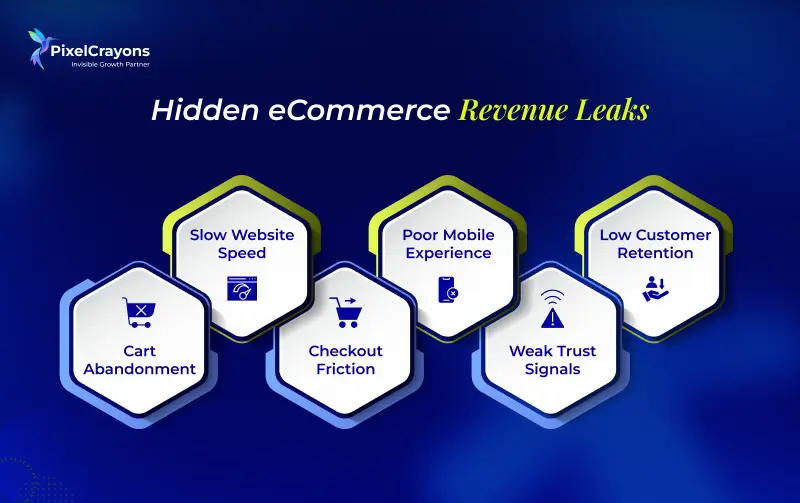
Revenue leaks are often disguised and therefore remain hidden and/or under-prioritised until it is too late. They are a normal part of growing a business, and may even be masked by high sales growth. Growing stores can often make mistakes that cause them to miss out on these revenues. Here are a few reasons why growing stores miss revenue leaks:
- Acquisition Over Optimisation: Marketing campaigns, paid advertising, SEO, social media, and eCommerce marketing services receive significant attention because they directly influence growth metrics.
- Growth Obscures: Growth in sales can disguise conversion rate reduction, rising bounce rates, shopping cart abandonment, etc.
- Looks Healthy, But Isn’t: Healthy-looking figures or simply “good enough” may disguise a need to invest in improvement levers.
- Small Leaks: Revenue leaks that seem small and isolated in themselves are often numerous and cumulative.
These factors create a false sense of security. Your business may appear to have healthy conversions and revenue while valuable growth opportunities remain hidden. It is, therefore, vital that organisations conduct a regular eCommerce revenue leak audit or internal performance review to identify these potential problem areas before they affect long-term sustainability and profitability.
Following an eCommerce audit checklist ensures every stage of the customer journey is reviewed consistently, making it easier to identify hidden growth opportunities. An eCommerce CRO audit helps identify which pages create friction and which optimisation opportunities will have the biggest impact on conversions.
Discover what's costing you sales and optimize your store for more conversions.
Revenue Leak #1 – Low-Converting Product Pages
Your product pages are one of the most critical elements of your sales process. If they don’t persuade customers to make a purchase, then they significantly hinder the success of the rest of your marketing initiatives. Many businesses use conversion rate optimization services to identify why product pages underperform and implement data-driven improvements.
Many underperforming product pages typically have missing product descriptions, images, comparisons, size guides, FAQs, and calls to action. This means that customers come to your page with questions and leave without answers.
Most of the time, you can identify underperforming product pages by looking at:
- A large number of page views with poor conversion rates.
- Low engagement, usually measured in time spent on the page.
- A high bounce rate.
- Numerous questions from customers before they make a purchase.
The reality is that having underperforming product pages negatively impacts your business in more ways than one. For every customer who fails to complete a purchase, you have a higher cost per acquisition (CPA) than you previously accounted for because you had to pay to acquire that customer in the first place.
You can typically improve underperforming product pages by addressing the intent of your customers. Thorough product descriptions, multiple images, videos, reviews, comparisons, and value propositions can assist customers in their buying journey and help you convince them to add your offering to their carts.
Revenue Leak #2 – Slow Website Performance
Website speed matters more than one thinks. A page that loads slowly pushes users away, increasing the bounce rate and reducing conversions. It is especially critical for mobile users, where every second counts. There are several reasons why eCommerce websites become slow, and addressing them is essential to protect conversions and revenue.
- Render-blocking CSS and JavaScript delay page rendering, increasing the time before users can interact with the page.
- Poor server-side caching forces the server to regenerate pages for every request instead of serving cached content.
- Unoptimized database queries slow down dynamic pages, especially as product catalogs and customer data grow.
- Excessive third-party scripts (analytics, chat widgets, heatmaps, tracking pixels, etc.) add network requests and increase page load times.
- Inefficient Content Delivery Network (CDN) configuration or the absence of a CDN results in slower asset delivery for users in different geographic regions.
- Large, unoptimized images and videos consume unnecessary bandwidth and delay page rendering, particularly on mobile devices.
- Unused CSS and JavaScript increase file sizes, forcing browsers to download and process code that isn’t needed.
That is why it is important to optimize your website, remove unnecessary code, compress images, add CDNs, enable browser caching, and monitor core web vitals. All that will help you provide a better user experience and drive more conversions.
Also Read: How to Use AI to Improve a Website’s User Experience
Revenue Leak #3 – Checkout Friction
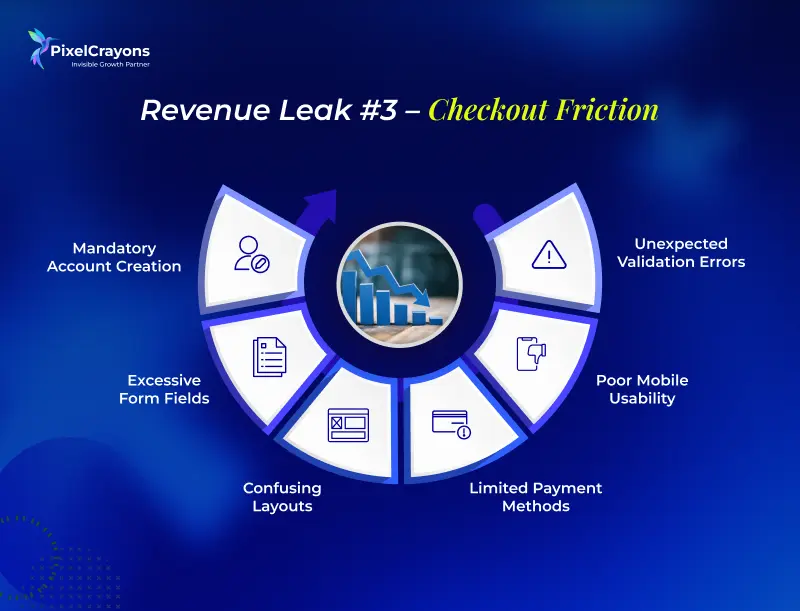
A customer on the checkout page does not automatically mean that they are now a guaranteed sale. The checkout process may be slow or unresponsive, making it difficult for customers to complete their purchases. Baymard Institute found that 17% of shoppers abandon their purchase because the checkout process is too long or complicated.
The more complicated the checkout process is, the higher your eCommerce cart abandonment rate becomes as customers leave before completing their purchase. A few reasons for checkout friction include:
- Mandatory account creation
- Excessive form fields
- Confusing layouts
- Limited payment methods
- Poor mobile usability
- Unexpected validation errors
Every step that acts as an obstacle makes it easier for the customer to switch websites. The checkout process should be smooth and devoid of any kind of barriers that hinder the purchase. Guest checkout, autofill support, digital wallets, progress indicators, and multiple payment options help customers complete purchases with minimal effort.
Find hidden conversion barriers, stop revenue leaks, and grow sales.
Revenue Leak #4 – Unexpected Costs
Nothing can ruin the purchasing process as fast as unexpected costs at the end of it. In other words, the appearance of additional expenses like shipping and handling, taxes, or even just unclear delivery timeframes, can hurt the sales conversion rate.
It is only natural for a customer to feel deceived when they see that the final price is significantly different from the one they expected. That is why it is so important to be transparent about the cost structure and provide the customer with all the relevant information before they make a purchase. After all, it is not the price that sells a product; it is the feeling of value.
Revenue Leak #5 – Weak Trust Signals
Online shoppers are constantly balancing whether they can trust your business. Without a physical store for them to browse through, online shoppers are relying on you to signal to them that they’re making the right choice. Failure to do so can lead to hesitant buying or even purchasing from your competitor instead. Trust signals that encourage customers to buy from you are:
- Customer reviews
- Product ratings
- Secure payment badges
- Return/refund policies
- Testimonials
- User-generated content
- Brand image
The reduction of trust barriers often leads to an increase in conversions.
Revenue Leak #6 – Poor Mobile Experience
For many online retailers, mobile devices are now the main source of traffic. However, the majority of online stores are still designed with desktops in mind. Small buttons, complicated menus, bad contrast, slow loading speed, and other issues significantly impact the user experience. Mobile users do not have the patience to deal with such challenges.
Every extra step, every unnecessary action, and every additional click on the mobile version of the website leads to a higher bounce rate. A mobile-optimised website would have larger buttons, better navigation, readable text, faster loading speed, and a better checkout process. Overall, it is critical to optimise the website for mobile devices in order to prevent the loss of sales.
Revenue Leak #7 – Abandoned Cart Recovery
Each abandoned cart represents lost revenue. Customers abandon their carts for various reasons, including getting distracted, comparing prices, worrying about payments, and losing interest. Your business loses the potential sale when you do not take any measures to recover abandoned carts. Some of the effective abandoned cart recovery techniques include:
- Automated email reminders
- SMS follow-ups
- Exit-intent offers
- Personalised product recommendations
- Time-sensitive incentives
The recovery process requires your attention to ensure that it is relevant and not annoying to your customers. Personalized and well-timed abandoned cart recovery reminds customers of items they intended to purchase and encourages them to go back and make the purchase. Abandoned cart recovery can help you generate substantial revenue even with a mild response rate.
More traffic won’t fix hidden conversion barriers. Identify the friction points in your customer journey and turn more visitors into paying customers.
Revenue Leak #8 – Weak Customer Retention
For many growing stores, improving customer retention delivers stronger long-term returns than continuously increasing acquisition budgets. Many companies are obsessed with attracting new clients but fail to focus on those they have already acquired. This is one of the biggest budget leaks in eCommerce.
Businesses investing in eCommerce marketing services often achieve stronger results when retention strategies are improved alongside acquisition campaigns. The money spent on convincing a new customer to make their first purchase is much higher than retaining an existing one. And loyal clients usually spend more, are easier to sell to again, and become brand ambassadors. Some effective examples of customer retention strategies are:
- Organizing loyalty programmes
- Offering personalized recommendations
- Sending emails after purchase
- Reminders about reordering
- Providing exclusive discounts
- Outstanding customer service
Moreover, increased retention means higher lifetime value of a customer. So, instead of constantly looking for new clients and spending a lot of money on them, companies can get more from those they already have.
Also Read: Understanding Customer Journey Optimization and How To Do it Right
Revenue Leak #9 – Poor Measurement & Analytics
Many companies are making decisions based on incorrect information, leading to losses. The absence of conversion tracking, improper attribution, insufficient analysis of customer behaviour, and reporting inconsistencies are some of the factors that end up creating blind spots for businesses. It is essential to utilise analytical tools to answer such questions:
- Where do customers abandon the buying journey?
- Which traffic sources generate the highest-value customers?
- Which product pages underperform?
- Which checkout steps create friction?
- Which experiments improve conversions?
Testing and measuring continuously allow businesses to make decisions based on facts rather than intuition.
Also Read: How to Measure the Success of an eCommerce Marketing Campaign?
Final Thoughts
A comprehensive eCommerce revenue leak audit often reveals that revenue leaks, though they appear in different forms, are rarely dramatic individually. Most of the time, they only account for some minor losses that greatly decrease the overall efficiency of a business. Luckily, it is usually easier and more effective to optimize the existing traffic sources and improve conversion rates instead of constantly searching for new customers. Baymard Institute estimates that improving checkout usability alone could increase conversions by approximately 35%, making optimisation one of the highest-ROI growth opportunities.
Using an eCommerce audit checklist also helps businesses prioritise improvements based on their potential impact instead of relying on assumptions. A thorough eCommerce CRO audit, combined with small CRO experiments, reduced friction, improved retention, and better use of analytics, can significantly improve conversion rates. Revenue leak audits, supported by conversion rate optimization services, should be regarded as a continuous process that helps increase profits and improve the customer experience over time.
A small optimization of the existing process can create substantial gains and help you get more value out of your existing investments. Therefore, it is crucial to perform an eCommerce revenue leak audit regularly to monitor potential leaks and examine them in detail before investing in new customer acquisition. Before investing further in digital marketing services or new traffic sources, analyse your existing revenue, expenses, and profit to understand where money is leaking.
Frequently Asked Questions (FAQs)
1. What are the best eCommerce strategies to maximize sales?
Ans. The most effective eCommerce strategies to maximize sales focus on improving the customer experience rather than simply increasing traffic. Optimising product pages, reducing checkout friction, strengthening customer retention, and regularly auditing your conversion funnel can help you generate more revenue from your existing visitors while lowering acquisition costs.
2. How can I improve customer-first checkout experience?
Ans. To improve customer-first checkout experience, simplify the purchasing process by reducing unnecessary form fields, offering guest checkout, supporting multiple payment methods, and ensuring the checkout works seamlessly on mobile devices. A faster and more intuitive checkout experience helps reduce cart abandonment and increases completed purchases.
3. What are some effective conversion optimization hacks for growing eCommerce stores?
Ans. Some of the most effective conversion optimization hacks include improving product page content, adding customer reviews and trust signals, speeding up website performance, testing different calls to action, and recovering abandoned carts with personalised follow-ups. These improvements can significantly increase conversions without requiring additional marketing spend.
4. How do agency partnerships to increase revenue benefit eCommerce businesses?
Ans. Agency partnerships to increase revenue give growing eCommerce businesses access to specialised expertise in areas such as conversion rate optimisation, digital marketing, analytics, and customer experience. By identifying revenue leaks and implementing data-driven improvements, the right agency partnership can help businesses increase sales while maximising the return on their existing marketing investments.
Discover the hidden issues reducing your conversions and profitability. Get a clear action plan to optimise your store and turn more existing traffic into revenue.