Running an agency often feels like a constant balancing act. One month, you are celebrating new client wins, and the next month, you are struggling to deliver as per the defined scope. To overcome this execution gap, many agencies turn to freelancers or plan to expand their in-house team even for short-term engagements. On the surface, hiring flexible talent like freelancers feels like an ideal way to scale faster. Nevertheless, it has its own share of setbacks that undermine trivial gains.
What looks like an efficient approach in the beginning may turn out to be an execution failure at some point. This is what we call “the freelancer trap,” which slowly eats up your agency’s profit margins. This blog post sheds light on the key challenges associated with hiring freelancers for agencies. Furthermore, it highlights the ideal approach to enhance execution capacity without hiring flexible talent.
Why Agencies Rely on Flexible Talent
Agency growth is rarely predictable. A sudden influx of projects or seasonal demand spikes can stretch internal teams beyond their execution capacity. In these situations, agencies need a quick and practical way to scale client delivery without slowing down momentum.
At the same time, many clients expect agencies to deliver multiple services including UI/UX design, development, and marketing. Building a full-time team for every skill set is expensive and often unnecessary, especially when demand fluctuates. This is when most agencies turn to freelancers, believing that ‘hiring flexible talent’ is probably the best way forward.
Moreover, growing agencies frequently face situations where additional support is required on an immediate basis, such as:
- New client onboarding with tight deadlines
- Multiple projects running simultaneously
- Seasonal or campaign-based workload surges
- Requests for niche expertise not available internally
To keep operations running smoothly and to overcome aforementioned challenges, agencies often choose flexible talent models, falling quickly into the freelancer trap.
Replace Freelancer Dependency With Reliable Execution
Deliver projects on time, maintain quality, and grow without operational stress.
The Freelancer Trap: How It Kills an Agency’s Margins
Freelancers are often the first choice for agencies that need to scale quickly. They offer flexibility, lower upfront costs, and access to specialized skills without long-term commitments. For short-term projects, this seems like an ideal solution.

However, as the project scope increases and client expectations grow, the hidden costs of relying heavily on freelancers begin to surface. What initially saves money can gradually take a toll on your client relationships, quietly eroding your profit margins. Let’s move ahead and explore hidden costs of freelancers for agencies as well as key challenges in growing an agency.
Inconsistency of Work
Every freelancer works differently. Processes, communication styles, and output quality may vary from one person to another. In fact, communication issues with freelancers are quite common across agencies.
This makes it difficult for agencies to maintain a consistent service experience across clients. Over time, inconsistent delivery can weaken trust and brand credibility.
Communication Gaps & Delays
Many freelancers manage multiple clients at once, often across different time zones.
This can lead to:
- Slow responses
- Missed updates
- Delayed revisions
- Project bottlenecks during urgent timelines
When communication slows down, delivery suffers.
Also Read: Upwork vs Freelancer vs Fiverr vs PixelCrayons – Know Which is Best
Rising Management Costs
Hiring freelancers for agencies may reduce initial upfront costs, but they often increase management effort, which may prove more expensive in the long run.
Agency leaders or account managers typically spend a significant proportion of their time on:
- Sourcing talent
- Onboarding new resources
- Reviewing work
- Coordinating timelines
- Managing revisions
With a white label execution partner, this time could be better invested in client growth and decision-making.
Client Retention Risks
As a result of hiring freelancers for agencies, deadlines slip, and quality becomes inconsistent. This may put a damper on your client relationships.
Even a few poor delivery experiences can lead to:
- Reduced client confidence
- Lower repeat business
- Negative referrals
- Lost long-term revenue
As a result, short-term savings from freelancers can eventually turn into long-term business losses.
White Label Execution: The Smarter Scaling Model for Agencies
As agencies grow and evolve, they require a more reliable delivery model to scale effectively without increasing overhead costs or overburdening their internal teams. This is where white label solutions come to the rescue.
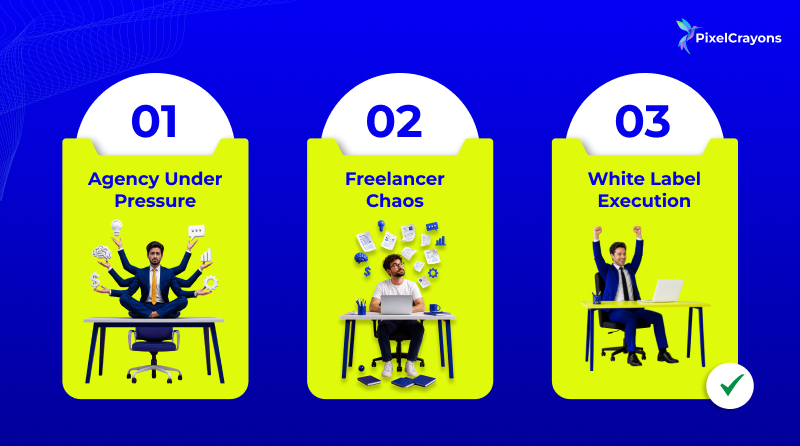
Instead of constantly chasing freelancers, agencies can opt for white label execution, a smarter scaling model which gives them access to an experienced delivery team, working as their own. This, in turn, allows them to scale faster while protecting margins and strengthening client relationships. For instance, agencies can avail white label services to onboard a dedicated software development team for their ongoing project needs. Let’s explore the key aspects of the white label execution model that agencies can leverage to boost their profit margins.
On-Demand Execution
White label execution gives agencies the flexibility to scale resources based on their current workload or project requirements. Whether it’s one urgent project or multiple ongoing accounts, teams can be expanded or adjusted quickly without lengthy hiring cycles. This enables agencies to respond faster to their clients’ growing needs with on-demand execution and offer better, scalable software development services to clients.
Predictable Costs, Better Margins
Unlike full-time hiring, white label services reduce fixed overhead and allow agencies to pay based on actual needs.
This leads to:
- Better cost control
- Easier project pricing
- Improved margin visibility
- Lower operational risk during slow periods
Instant Access to Distinct Talent
Agencies often require different skill sets across projects. That being said, white label partners like PixelCrayons provide instant access to skilled professionals across a gamut of different domains and specializations, including:
Instead of hiring freelancers for agencies, adopting this model gives you multi-skilled expertise under one roof for reliable execution at scale.
Consistent Quality & Processes
Established white label teams follow defined workflows, delivery standards, and project management systems.
This helps ensure:
- Reliable turnaround times
- Better communication
- Fewer errors and rework
- Consistent client outcomes
As a result, consistency becomes easier to maintain as the agency scales.
Discreet Delivery Under the Agency’s Label
With white label solutions, all work is delivered under the agency’s own brand, allowing it to remain the face of the client relationship. Clients experience seamless service, while the agency retains ownership of communication, strategy, and growth. It’s a scalable model that strengthens reputation without increasing internal complexity.
Improve Profit Margins With Smarter Resourcing
Scale client delivery with dedicated specialists and cost-efficient execution models.
Freelancer-led Delivery vs White-Label Execution
As agencies scale, choosing the right delivery model directly impacts profitability, efficiency, and client satisfaction. While freelancers and in-house teams may work in certain situations, white label execution often provides the best balance of flexibility, control, and growth potential.
|
Aspect(s)
|
Freelancers
|
White Label Execution
|
|
Cost Structure
|
Variable costs, but hidden expenses from revisions and management
|
Flexible pricing based on project needs with lower overhead
|
|
Scalability
|
Limited by individual availability
|
Fast and easy resource scaling based on workload
|
|
Quality Consistency
|
Can vary between individuals
|
Standardized processes and dependable delivery
|
|
Speed to Start
|
Usually quick for short-term tasks
|
Quick onboarding with ready teams
|
|
Management Effort
|
High coordination and follow-ups required
|
Low operational burden with managed execution
|
|
Skill Coverage
|
Depends on finding multiple freelancers
|
Access to multi-skilled specialists under one roof
|
|
Reliability
|
Uncertain during peak demand
|
Reliable with scalable team capacity
|
|
Client Experience
|
Can be inconsistent across projects
|
Seamless and consistent under agency branding
|
|
Profit Margin Protection
|
Lower due to inefficiencies and rework
|
Strong through efficient, scalable delivery
|
|
Best For
|
One-off or short-term tasks
|
Agencies focused on growth and margin efficiency
|
Transitioning to a White Label Growth Model
Switching to a white label execution model is an effective way to overcome agency profitability challenges that impede growth. With the right approach, agencies can improve efficiency, scale faster, and protect margins without disrupting client relationships. Let’s see how agencies can make a swift transition to white label execution methodologies.
Audit Current Delivery Bottlenecks
Start by identifying where your agency is losing time, money, or momentum.
Look for issues such as:
- Missed deadlines or delayed launches
- Overloaded internal teams
- Heavy dependence on freelancers
- Frequent revisions or quality concerns
- Leadership time spent managing execution
These bottlenecks often reveal where external delivery support can create the fastest impact.
Identify Services to Outsource Seamlessly
Not every function needs to be outsourced first. Begin with execution-heavy services that can run smoothly in the background.
Common areas include:
This allows your internal team to stay focused on strategy and client management.
Also Read: Managing Multiple Marketing Vendors? Here’s the Real Cost You’re Paying
Choose a Reliable White Label Partner
Your growth depends on the quality of the delivery partner you choose.
Look for white label partnerships with:
- Proven technical expertise
- Strong communication processes
- Transparent workflows
- Scalable team capacity
- Consistent turnaround times
- Experience working with agencies
The right partner should feel like an extension of your own team.
Focus on Strategy & Client Growth
With a white label partner handling client deliveries, in-house teams within agencies can shift their attention to high-value work such as:
- Winning new clients
- Growing existing accounts
- Strengthening relationships
- Improving strategy and consulting
- Expanding service offerings
Grow Your Agency Without Expanding Overhead
Partner with PixelCrayons to scale delivery, retain clients, and increase profitability.
Wrapping Up
Hiring freelancers for agencies may offer quick relief, but it rarely supports profitable, scalable agency growth. In this blog post, we have already explored the hidden costs of freelancers for agencies. As client demands increase, hidden costs, management complexity, and delivery limitations can quickly impact margins. White label execution offers a more balanced path; combining flexibility, consistent quality, specialized expertise, and predictable costs under your brand.
PixelCrayons helps growing agencies scale efficiently with reliable white label teams across design, development, marketing, and support. Our flexible engagement models help you reduce overhead, protect margins, and focus on client growth while we handle execution.
Scale Your Agency Smarter with PixelCrayons Today. Contact us for more details.
Frequently Asked Questions
1. Should agencies hire software developers in-house or outsource them?
Ans. It depends on your growth stage and workload. In-house developers offer control, while outsourcing or white label teams provide faster scalability, lower overhead, and access to broader expertise.
2. What are the biggest challenges in growing an agency?
Ans. Common challenges include managing rising workloads, hiring the right talent, maintaining service quality, meeting deadlines, and protecting profit margins while scaling operations.
3. Are freelancers a good option for agencies?
Ans. Freelancers can help with short-term or one-off tasks, but relying heavily on them may create issues like inconsistent quality, limited availability, and higher management effort.
4. How can agencies scale without increasing internal costs?
Ans. Agencies can scale through white label execution or outsourced teams that provide flexible resources on demand, helping reduce hiring costs and fixed overhead.
5. When should an agency move beyond freelancers?
Ans. An agency should consider alternatives when project volume grows, deadlines become harder to manage, quality varies, or too much time is spent coordinating multiple freelancers.

AI, SaaS & Digital Experience Strategist
Emma Joseph is a B2B writer and digital strategist with 7+ years of experience in the field of AI, SaaS, web development, eCommerce, UX, CRO, and digital marketing. Her work examines how emerging technologies and data-driven marketing enable organizations to accelerate growth.
Her expertise spans AI adoption, SaaS growth, website optimization, UX strategy, conversion optimization, and digital marketing. She focuses on translating complex technical concepts into practical business insights, enabling decision-makers to evaluate technologies, optimize digital experiences, and make informed investment decisions.
At PixelCrayons, Emma develops research-driven content for startup founders, business leaders, CMOs, CTOs, product teams, eCommerce brands, and digital agencies. Her writings cover AI, modern web technologies, performance marketing, and scalable growth strategies, with an emphasis on practical implementation and measurable business outcomes.
Emma’s writing reflects an execution-first perspective, combining technical depth with commercial relevance. She is committed to producing accurate, evidence-based content that helps organizations navigate digital transformation, improve customer experiences, and build sustainable growth through technology.
Let’s Connect Linkedin | Facebook
#WhiteLabelServices #BlockchainDevelopment #AIIntegration #Web3 #MachineLearning #DeFi #SmartContracts #AgencyGrowth #EmergingTechnologies


