A buyer needs a software solution. Instead of searching Google, opening multiple tabs, and comparing ten blue links, they ask ChatGPT:
“Which enterprise software vendor is best for mid-sized manufacturing companies?”
The AI does not give a list of search results. It compares sources and provides a direct answer. It may cite the brands and websites it used.
Your brand is either part of that answer, or it is not.
This is the difference between traditional search and AI powered discovery. For more than two decades, businesses have focused on Search Engine Optimization (SEO) to improve rankings and drive website traffic. Now, buyers are increasingly using AI assistants such as ChatGPT, Gemini, Claude, and AI-powered search experiences to find information and evaluate brands.
That is where Answer Engine Optimization Services comes in. For teams like PixelCrayons, which work across digital strategy, content, and development, this shift is already changing how websites are structured, how content is written, and how visibility is measured.
The question is no longer simply Answer Engine Optimization vs SEO. The more important question is how both disciplines work together.
SEO still matters. But the way people search, the way information is retrieved, and the way brands earn visibility are changing.
Also Read: AI and SEO: Understanding the New Landscape of Search

If buyers ask AI before they visit your website, your content needs to be clear, structured, and citation-ready.
Table of Contents
AEO vs SEO: What’s the Difference?
The simplest way to understand the difference is this:
SEO helps your website rank in search results. AEO helps your content become part of the answer.
|
Factor |
SEO |
AEO |
|
Primary goal |
Rank higher in search results |
Become a cited or referenced source in an AI-generated answer |
|
Search behaviour |
Keywords and short phrases |
Natural language questions and conversations |
|
Content focus |
Ranking pages |
Providing direct, clear answers |
|
Content structure |
Headings, keywords, links, metadata |
Answer-first content, structured data, entities and clear information |
|
Main trust signals |
Backlinks, authority and rankings |
Entity clarity, data consistency, citations and source quality |
|
Key visibility metric |
Rankings and organic traffic |
Citations, mentions and inclusion in AI answers |
|
User journey |
Search, click, read, compare |
Ask, receive, evaluate and continue the conversation |
This is how AEO is different from SEO. The two approaches have different goals, but they increasingly rely on many of the same fundamentals.
AI systems do not just match words. They interpret entities, context, and relationships.
From Finding Pages to Getting Answers
Traditional search puts the user in control of the research process.
A user searches for a query. The search engine retrieves relevant pages. The user then visits different websites, compares information, and decides what to trust.
SEO has traditionally focused on improving visibility within this process. Marketers research keywords, create content, build links, improve technical performance, and work to rank higher in search results.
AI search changes the experience.
When a user asks an AI assistant a question, the system interprets the meaning and context behind the query. It may use information from its training data, live search results, or Retrieval-Augmented Generation (RAG) systems to generate a direct response.
The AI becomes the researcher and editor.
Instead of presenting ten pages for the user to review, it may summarise information from several sources and provide one answer.
This means your content must be more than relevant to a keyword. It must be clear enough for an AI system to understand, trust, extract, and connect to the wider topic.
For example, a page targeting the keyword “CRM software” may perform well in traditional search because it is optimised around the term and supported by strong backlinks.
However, an AI system may need to understand much more:
- What the company does
- Who the software is designed for
- Which industries it serves
- How it compares with alternatives
- What problems it solves
- What evidence supports its claims
This is why AEO focuses heavily on context.
At PixelCrayons, this is the kind of shift that matters most. Not just ranking a page, but making sure the page can be understood, extracted, and trusted by both people and AI systems.
Also Read: Discover AI Use-Cases, Benefits, and Tips to Transform Your Business in 2026
1. Keyword Strategy Is Expanding Beyond Keywords
SEO has traditionally focused on keywords.
Marketers identify the terms people search for, analyse search volume and competition, and create content around those terms.
That process remains useful. However, AEO requires a broader view.
AI systems do not only match exact words. They try to understand entities, concepts, and relationships.
For example, a search for “Apple” could refer to a fruit, a technology company, or a record label. Context helps the system understand which meaning is relevant.
This means your content should clearly establish:
- What your brand is
- What products or services you offer
- Who you serve
- Which problems you solve
- Which topics you are associated with
- How you compare with relevant alternatives
Instead of creating one page for every variation of a keyword, a stronger SEO and AEO strategy connects related topics into a clear knowledge structure.
This is one of the key differences in the Answer Engine Optimization vs SEO discussion. SEO often begins with the search term. AEO begins with the subject, the question, and the surrounding context.
2. Content Needs to Be Easy for Humans and Machines to Understand
Good SEO content should be easy to read.
Good AEO content must also be easy to extract and interpret.
This makes structure increasingly important.
A clear page should use:
- Descriptive headings
- Short paragraphs
- Direct answers
- Lists where appropriate
- Tables for comparisons
- Clear definitions
- Relevant internal links
- Structured data where applicable
For example, if you are explaining how to choose an ecommerce platform, a table may help users compare pricing, scalability, integrations, and use cases.
It also gives AI systems a clearly structured set of relationships to understand.
Schema markup plays a similar role. Using structured data such as JSON-LD can help search engines understand whether a page contains a product, organisation, FAQ, review, article or how-to guide.
However, schema alone is not a shortcut to AEO visibility. It should support content that is already accurate, useful and well structured.
The larger goal is simple: remove ambiguity.
If a paragraph makes a claim, make the claim clear. If a page answers a question, answer it directly. If your company offers a service, explain what the service includes and who it is for.
AI systems have little use for vague marketing language that sounds impressive but says very little.
If your content is not structured for retrieval, AI may answer the question without mentioning you.
3. The Goal Is Moving Beyond the Click
For years, one of the most important SEO metrics has been organic click-through rate.
That made sense when search engines primarily directed users to websites.
AI search creates a different challenge.
A user may receive the answer directly in ChatGPT or an AI Overview without visiting your website. This creates a zero-click environment.
Does that mean traffic no longer matters? No.
It means visibility now exists in more than one place.
A brand can be discovered through:
- A traditional organic result
- A featured snippet
- An AI Overview
- A ChatGPT recommendation
- A citation in an AI-generated answer
- A brand mention within a conversational response
This makes citation and brand visibility increasingly important.
If an AI system repeatedly identifies your company as a relevant source for a particular topic, your brand may influence buying decisions even when the user does not click through immediately.
The conversion may happen later, after the buyer searches for your brand directly, visits your website, or speaks to your sales team.
This is also where AEO and GEO for conversion optimization become important. The goal is not simply to be mentioned by AI. The goal is to ensure that the information being surfaced is accurate, relevant and persuasive enough to support the next step in the buyer journey.
4. Search Intent Is Becoming Conversational
Traditional SEO often maps content to search intent.
A user may search:
“Best accounting software for small businesses.”
Then they may search:
“Which one integrates with Shopify?”
Then:
“Which is better for a business with 20 employees?”
In traditional search, each query may be treated as a separate search.
In an AI conversation, these questions may form one continuous discussion.
The system can use the context from the previous question to understand the next one.
This changes how brands should create content.
Content should not only answer isolated questions. It should also address the logical follow-up questions that naturally come next.
For example, a page about fintech software development services may need to explain:
- What the service includes
- Which financial products it supports
- How compliance is handled
- What technologies are used
- How long development may take
- How the solution can scale
This creates a more complete information environment for both users and AI systems.
How to Optimize for AI Search
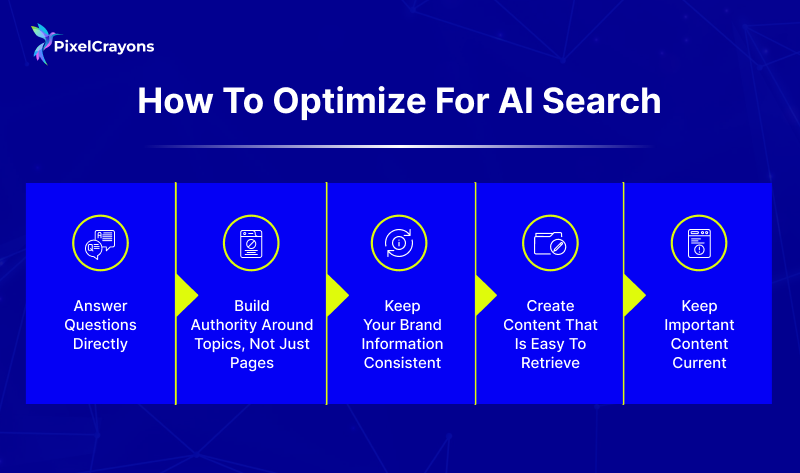
If you are wondering how to optimize for AI search, start with the fundamentals. AEO is not about writing content for machines instead of people.
It is about making useful information easier to understand.
1. Answer questions directly
Identify the questions your customers ask before, during, and after a purchase.
Then answer them clearly.
Start with the answer rather than several paragraphs of background information. Follow the direct answer with context, examples, or supporting evidence.
For example:
What is Answer Engine Optimization?
Answer Engine Optimization is the process of structuring and improving digital content so AI-powered search systems can understand, retrieve, and reference it when answering user questions.
The explanation can then continue with examples and supporting detail.
This answer-first format helps users find what they need quickly while making the content easier to interpret.
2. Build authority around topics, not just pages
A single article rarely establishes strong authority on a complex subject.
A stronger approach is to create connected content around a topic.
For example, a company offering digital marketing services may publish content covering:
- SEO strategy
- Content marketing
- PPC
- Conversion optimization
- AI search
- AEO
- GEO
- Analytics
These topics should be connected through internal linking and consistent explanations.
Over time, this helps establish a clearer relationship between the company and the subjects it covers.
Also Read: Building Topical Authority? How to Get It Right the First Time?
3. Keep your brand information consistent
AI systems rely on information from many sources.
If your company name, services, location, description, or industry information is inconsistent across the web, it becomes harder for systems to understand the entity.
Review information across:
- Your website
- Business directories
- Industry websites
- Social profiles
- Review platforms
- Partner websites
- Knowledge databases
Consistency matters because AI needs to understand that different mentions refer to the same organisation.
4. Create content that is easy to retrieve
AI systems often retrieve smaller sections of content rather than using an entire page.
This makes content organisation important.
Use clear sections. Define terms. Use numbered steps for processes. Use tables for comparisons. Add supporting evidence where possible.
A page should still make sense when one section is read independently.
This is particularly important for SEO for ChatGPT and AI search, where the system may use a specific passage to generate an answer.
5. Keep important content current
Freshness matters in many industries.
Pricing changes. Technology evolves. Regulations are updated. Consumer behaviour shifts.
A page that was accurate three years ago may no longer be reliable.
Review important content regularly. Update statistics, examples, and recommendations. Make the publication or update date clear when appropriate.
Freshness is not about changing a date without changing the content. It is about keeping information genuinely useful.
Founded in 2004. 2,500+ projects delivered. 100+ agency partnerships. Built for answer-ready content that performs across search and AI.
Is AEO Replacing SEO?
No. AEO is not replacing SEO. It is expanding the search visibility landscape.
This is one of the most important points for marketers.
Traditional search still plays a major role in discovery. People continue to use search engines to find products, services, businesses, reviews and information.
AI systems also often rely on search infrastructure and online sources to generate answers.
Strong SEO fundamentals therefore remain important.
Technical performance, high-quality content, relevant links, authority and a strong user experience still support visibility.
The difference is that these fundamentals now need to work alongside:
- Structured content
- Entity optimisation
- Direct answers
- Consistent brand information
- Clear source attribution
- AI-friendly content architecture
In other words, the future of AI and SEO is not necessarily a competition between two separate disciplines.
It is a more integrated search ecosystem.
Also Read: The Complete Guide to SEO Services: What You Need to Know
What This Means for Your SEO Strategy in 2026
If you are asking how SEO is evolving in 2026, the answer is simple: visibility is becoming more distributed.
Your brand may need to appear across traditional search results, AI-generated answers, social platforms, industry websites, and other digital environments.
This makes a single-channel SEO strategy less effective.
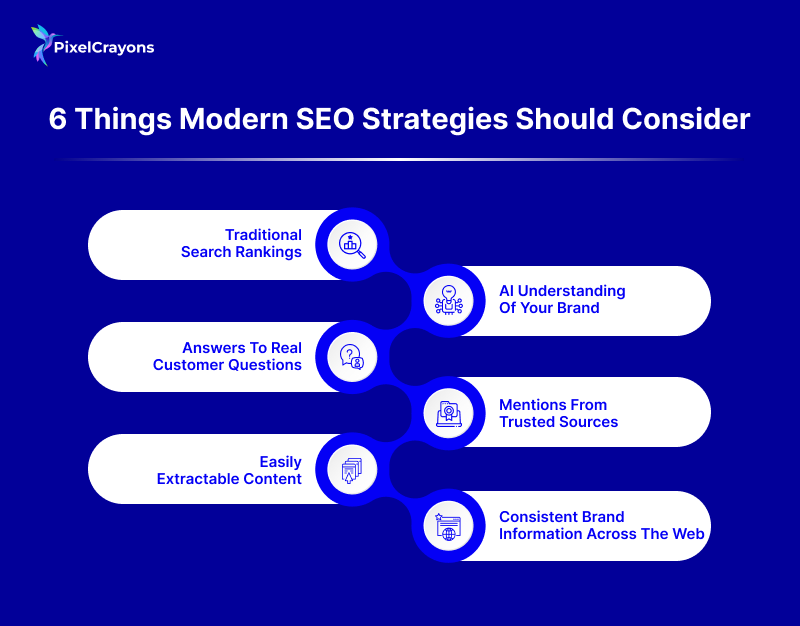
Modern SEO strategies should consider:
- How your website ranks in traditional search
- How clearly AI systems understand your brand
- Whether your content answers real customer questions
- Whether other trusted sources mention your company
- How easily information can be extracted from your content
- Whether your brand appears consistently across the web
Businesses may also need support from a specialised SEO services provider that understands both traditional search and AI-driven discovery.
For agencies, this can also create new opportunities. Partnering with a provider that offers GEO services for agencies can help expand client offerings without requiring every capability to be developed internally.
Similarly, organisations looking to improve their visibility across search, AI platforms and other digital channels may consider Answer Engine Optimization services as part of a broader digital marketing strategy.
The Future of Search Is Hybrid
The most effective approach is unlikely to be SEO versus AEO. It will be SEO plus AEO plus GEO.
- SEO helps your content remain discoverable in traditional search.
- AEO helps answer engines understand and use your information.
- GEO focuses on improving visibility within generative AI experiences.
Together, these disciplines support a broader approach to digital visibility.
The brands that perform well will not necessarily be the ones that publish the most content. They will be the ones that make their information easiest to understand, verify, and use.
- Your website should clearly explain what you do.
- The content should answer the questions your audience actually asks.
- Your brand information should be consistent.
- Claims should be supported by evidence.
The AI era does not eliminate the need for good marketing. It makes clear, useful marketing even more important.
Also Read: What is GEO and Why It Is Important in 2026?
Conclusion
The difference between SEO and AEO comes down to how information is discovered. SEO helps your website appear when someone searches for a topic. AEO helps your brand become part of the answer when someone asks an AI system about that topic.
So, Answer Engine Optimization vs SEO is not an either-or decision. SEO remains the foundation. AEO extends that foundation into a new search environment where users increasingly ask questions instead of entering keywords, and where AI systems increasingly decide which sources deserve to be included in the answer.
The right response is not to abandon SEO. It is to evolve your SEO strategies. Make your content clearer. Structure information better. Strengthen your authority. Keep your data consistent. Answer real questions directly.
The future of search will belong to brands that can be found, understood, and trusted across both traditional search engines and AI-powered answer engines.
Frequently Asked Questions (FAQs)
1. What is the difference between AEO and SEO?
Ans. SEO helps websites rank in traditional search results. Answer Engine Optimization helps content appear in AI generated answers. AEO focuses on clear answers, structured content, entities, citations, and context. PixelCrayons combines SEO, AEO and GEO strategies to help businesses improve visibility across search engines and AI powered search platforms.
2. Is AEO replacing SEO?
Ans. No. AEO is not replacing SEO. Technical SEO, quality content, authority, and relevant links still matter because AI systems often rely on information from search engines and trusted websites. PixelCrayons helps businesses evolve their SEO strategies by combining traditional SEO with Answer Engine Optimization services and AI search optimization.
3. How do you optimize content for AI search?
Ans. To optimize content for AI search, create clear answers, use a logical structure, maintain consistent brand information and support important claims with reliable sources. Content should be easy for both people and AI systems to understand. PixelCrayons combines SEO, AEO and GEO services to help businesses improve visibility across traditional and generative search.
4. What are Answer Engine Optimization services?
Ans. Answer Engine Optimization services help businesses make their content easier for AI powered search systems to understand, retrieve, and reference. These services may include content restructuring, entity optimization, schema implementation, and question based content planning. PixelCrayons combines these services with broader digital marketing services to support a complete search visibility strategy.
5. How can an SEO services provider help with ChatGPT and AI search?
Ans. An experienced SEO services provider can help your business improve visibility across both traditional search and AI powered platforms. PixelCrayons reviews your existing SEO strategies, content structure, authority, and entity consistency to identify opportunities for SEO for ChatGPT and AI search, AEO, and GEO. This helps businesses prepare for how SEO is evolving in 2026.
Find out what is holding back your visibility across search and AI. Get a clear action plan to fix it.