For years, content marketing followed a simple formula: publish more content, attract more traffic, and convert some of that traffic into leads.
But more content does not necessarily mean more pipeline.
High growth companies take a different approach. Instead of treating content as a publishing exercise, they use a content marketing strategy designed around buyer needs, distribution, and pipeline contribution.

Let's connect virtually or ask for an estimate of your project.
Table of Contents
The Volume Model Is Losing Its Advantage
Buyers have more information available than they can practically consume. Publishing another generic article does not necessarily create another opportunity.
Especially with AI generated summaries becoming more prominent in search results, users increasingly get answers without visiting the websites. Thus, how AI search is changing content marketing has become an important question for marketers.
Ranking alone is no longer enough. Content needs to provide information that search engines and AI systems can understand, summarize, reference, and cite.
Hence, instead of asking, “How many articles can we publish this month?” marketers need to ask:
Does this content answer an important buyer question, reach the right audience, and help move an opportunity forward?
That is the difference between content production and content marketing.
Let's connect virtually or ask for an estimate of your project.
The Volume Model Is Losing Its Advantage
Buyers have more information available than they can practically consume. Publishing another generic article does not necessarily create another opportunity.
Especially with AI generated summaries becoming more prominent in search results, users increasingly get answers without visiting the websites. Thus, how AI search is changing content marketing has become an important question for marketers.
Ranking alone is no longer enough. Content needs to provide information that search engines and AI systems can understand, summarize, reference, and cite.
Hence, instead of asking, “How many articles can we publish this month?” marketers need to ask:
Does this content answer an important buyer question, reach the right audience, and help move an opportunity forward?
That is the difference between content production and content marketing.
Replace content volume with a focused strategy built around buyer intent, AI search, conversion, and revenue.
Also Read: How to Power Your SEO Content With AI
Start With Buyers, Not a Publishing Calendar
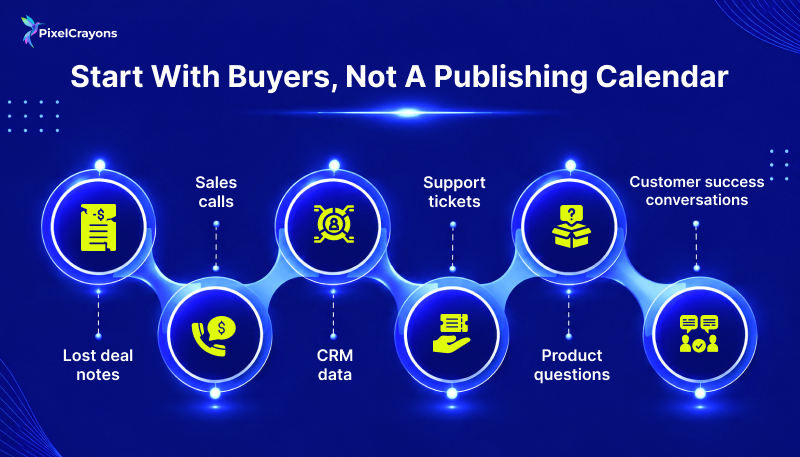
High growth companies do not begin their planning process by filling 12 weeks of blog topics.
They start with customer and revenue data.
- Sales calls
- Support tickets
- Customer success conversations
- Product questions
- Lost deal notes
- CRM data
These sources reveal what buyers actually need to know before they purchase.
For example, if prospects repeatedly ask whether a solution can integrate with their existing systems, that question should become more than a sales response. It could become a detailed integration guide, comparison page, implementation FAQ, or customer case study.
The same principle applies to objections around pricing, implementation time, security, switching costs, and internal adoption. This approach makes content more relevant because it reflects real buying situations.
A strong B2B content strategy pipeline growth model therefore connects content planning directly to sales conversations.
Create Content for Specific Buying Stages
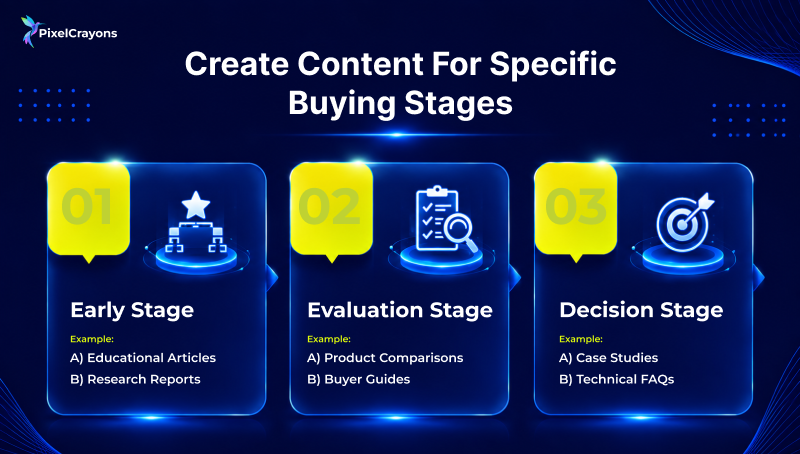
The average B2B purchase involves seven decision makers and 62 or more touchpoints over six months. Different people enter the process with different questions.
A finance leader cares about total cost of ownership. A technical buyer wants integration details. A marketing leader wants evidence of performance. An executive wants to understand business impact and risk.
One generic blog post cannot address all of these needs. Your content should therefore have a defined role within the buying journey.
Early Stage
Early stage content helps buyers understand a problem.
Examples include:
- Industry trends
- Problem focused guides
- Educational articles
- Research reports
- Diagnostic checklists
Evaluation Stage
Mid-funnel content helps buyers compare options and assess solutions.
Examples include:
- Product comparisons
- ROI calculators
- Implementation guides
- Feature explainers
- Buyer guides
- Use cases
Also Read: 11 Digital Marketing Trends That Will Continue in 2026
Decision Stage
Bottom funnel content helps reduce the final barriers to purchase.
Examples include:
- Case studies
- Customer proof
- Pricing information
- Security documentation
- Technical FAQs
- Implementation plans
This structure turns content into part of the sales process rather than a separate marketing activity.
Fewer Flagship Assets, More Useful Content
A high performing AI content strategy does not mean using AI to produce hundreds of articles.
It means using technology to improve research, content analysis, personalization, and distribution while keeping subject matter expertise at the center.
The same principle applies to traditional content.
Instead of publishing four average blog posts every week, consider creating one comprehensive resource that answers a meaningful buyer question.
Long form content of more than 2,000 words has been associated with stronger lead generation than short form content. FAQ focused content can also improve visibility in AI generated answers, while original research is particularly valuable because AI systems need credible, distinctive sources to reference.
A strong flagship asset can then support multiple pieces of content.
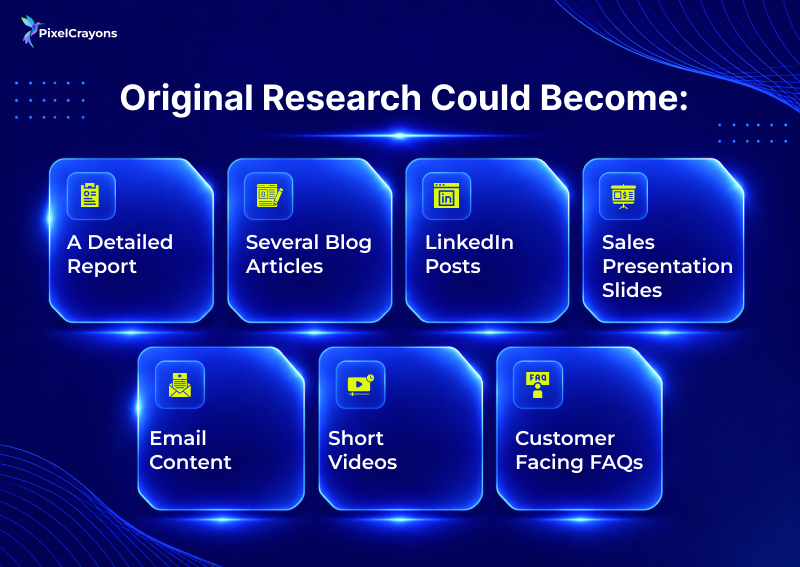
For example, original research could become:
- A detailed report
- Several blog articles
- LinkedIn posts
- Sales presentation slides
- Email content
- Short videos
- Customer facing FAQs
The result is not less content. It is more value from each piece of content created.
That is one of the practical content marketing secrets many high growth companies understand: the best content is designed for reuse from the beginning.
Also Read: Top AI Tools to Automate Your Digital Marketing
Distribution Matters as Much as Creation
The goal is not to publish the same article everywhere. Each channel should adapt the core idea to its audience and format.
For example, a 3,000 word research report could become a LinkedIn data series for executives, a sales enablement deck for account teams, an email sequence for prospects, and several search focused articles answering specific questions.
This is where content marketing services can add value beyond writing. A capable team should be able to connect research, production, SEO, distribution, conversion, and measurement into one system. Providers like PixelCrayons support businesses in building this end to end content engine.
For companies working with a digital marketing agency, this also creates a useful test: content should not operate separately from paid media, SEO, CRO, email, or sales enablement. The channels should reinforce each other.
AI Search Requires a Different Content Strategy
AI readiness does not mean writing for machines. It means making content genuinely useful and clearly structured.
For example, instead of writing an article titled “The Future of B2B Marketing,” a company could:
- Answer a specific question such as “How long does a B2B content strategy take to generate a pipeline?”
- Focus on a clearly defined search intent rather than a broad theme
- Align the topic with a real business decision or buying stage
This is one of the most important content marketing trends to watch: content must increasingly earn visibility through usefulness, authority, and evidence rather than simply matching keywords.
Also Read: B2B vs. B2C Digital Marketing: How Strategy & Execution Differ
Measure Pipeline, Not Just Traffic
A page can attract thousands of visitors and generate almost no commercial value.
A smaller page that influences several high value opportunities may be far more important to the business.
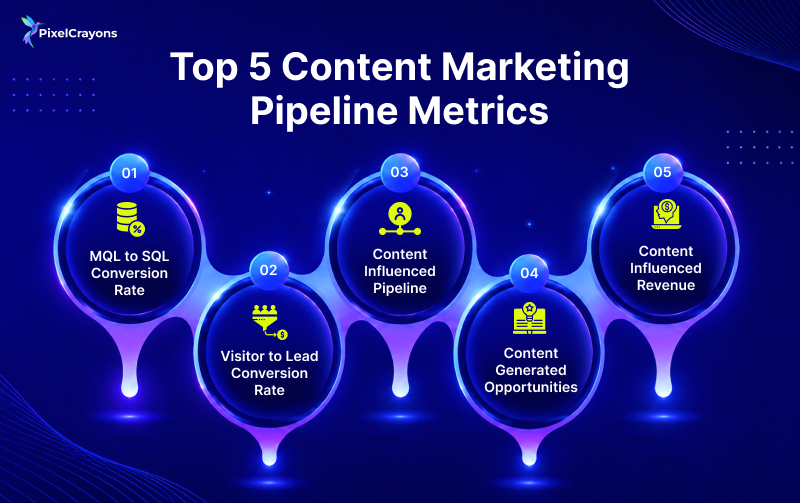
This is why content marketing pipeline metrics should include measures such as:
- Content assisted opportunities
- Content influenced revenue
- Lead to opportunity conversion
- Opportunity to customer conversion
- Sales cycle velocity
- Pipeline generated by content
- Revenue influenced by specific assets
- Conversion rate by content type
Engagement metrics such as time on page and scroll depth also help determine whether visitors are actually consuming the content.
The important question is therefore not simply how many people arrived. It is what happened after they arrived. That is where content marketing ROI becomes meaningful.
Connect content performance to opportunities, revenue, and sales velocity with the right content marketing pipeline metrics.
A Practical Pipeline First Content Framework
Moving from volume to value does not require rebuilding the entire marketing operation overnight.
Start with a focused audit.
1. Audit Existing Content
Identify your ten most valuable content assets based on revenue influence, conversions, qualified leads, and opportunity engagement.
Do not rank them only by page views.
Some of your most commercially valuable content may have relatively low traffic.
2. Find Pipeline Gaps
Map existing content against the buyer journey.
If you have 50 educational blog posts but no implementation guide, comparison page, or case study, you have a content gap even if your website looks busy.
3. Mine Sales and Customer Questions
Create a regular feedback loop between marketing, sales, and customer success.
Ask:
- What questions keep coming up?
- What objections stop deals?
- Why do prospects choose competitors?
- Where do customers struggle after purchase?
These answers provide a steady source of useful content ideas.
4. Plan Distribution Before Production
Before creating an important asset, define where it will be distributed and who will use it.
This prevents distribution from becoming an afterthought.
5. Refresh Before Creating More
Look at existing content before adding another article to the calendar.
Update outdated statistics. Improve structure. Add original insights. Strengthen internal links. Add relevant CTAs. Address questions that buyers now ask.
Often, improving an existing high potential page is more valuable than publishing another generic article.
The Role of Content Expertise
A pipeline-focused content program requires an understanding of:
- Search behavior
- Buyer psychology
- SEO
- Conversion paths
- Analytics
- Distribution
- Commercial goals of the business
That is where content consulting services help. Instead of simply producing more articles, a content consultant or strategic partner identifies where content is helping revenue and where it is creating activity without business impact.
The strongest programs combine strategy with execution.
They use data to decide what to create, subject matter expertise to make it credible, SEO to make it discoverable, distribution to expand its reach, and CRO to turn attention into action.
Get strategic content execution backed by 2,500+ projects, 21 years of delivery experience, and 85%+ year over year retention.
Conclusion: Content Should Earn Its Place in the Pipeline
Content volumes continue to rise. And companies have more data available to understand what actually influences revenue.
The response should not be another larger content calendar. It should be a better content marketing strategy.
Publish what buyers need. Build around real questions. Create assets worth sharing. Distribute them deliberately. Measure their contribution to pipeline.
That is how content moves from a marketing activity to a revenue asset.
Let's connect virtually or ask for an estimate of your project.