Most businesses write content to rank. They chase keywords and search visibility. This brings traffic, but that traffic rarely does anything. It doesn’t book a demo. It doesn’t request a quote. It doesn’t become a lead.
A good content strategy for pipeline generation fixes this. It stops chasing pageviews and starts chasing business outcomes. Does the content reach the right people? Does it shape how they buy? Does it create a sales opportunity? Every blog, landing page, case study, and webinar must have one clear job in the buyer journey.
This guide walks through a five phase framework for a content-led growth strategy. It attracts the right prospects and drives real growth.

Move beyond traffic. Turn content into qualified leads, sales opportunities, and measurable revenue with a proven B2B framework.
Table of Contents
Phase 1: Focus on Value, Not Volume.
Marketing teams celebrate pageviews, impressions, and social shares. These numbers feel good. But they don’t tell you if content is helping the business grow. A blog with 20,000 visitors and zero leads is worth very little.
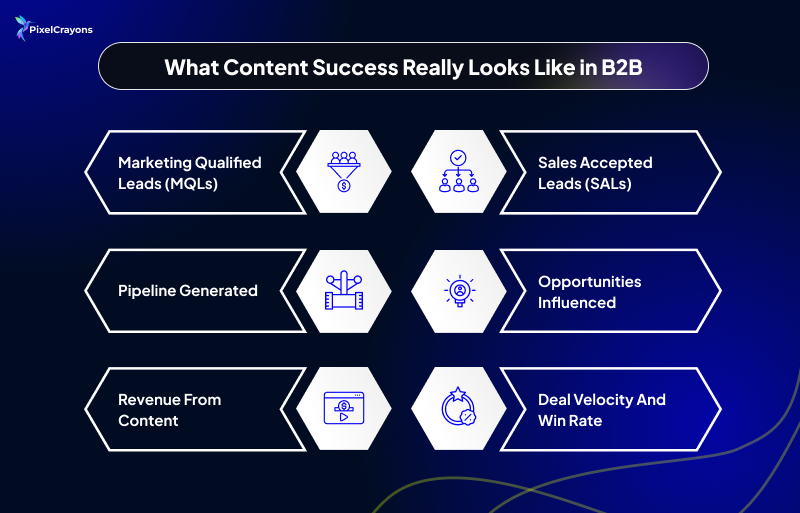
Track what actually matters instead:
- Marketing Qualified Leads (MQLs)
- Sales Accepted Leads (SALs)
- Pipeline generated
- Opportunities influenced
- Revenue from content
- Deal velocity and win rate
These numbers show whether your content strategy for the sales pipeline is really working. If not, it is high-time you should think about opting for value-driven SEO services and CRO services that cover end-to-end content marketing.
Phase 2: Understand Your Audience and Their Buying Intent
A good content strategy for pipeline generation starts with one thing: knowing who you’re writing for. Not just their company size or industry. You need to know:
- What problems are they trying to solve?
- What’s slowing down their growth?
- What goals are they judged on?
- What stops them from buying?
- What do they need to know before they say yes?
Most B2B purchases involve more than one person. Each one cares about different things. Your content needs to speak to all of them.
Talk to your sales team. Talk to customer success and support. Ask what questions come up again and again. If five prospects ask the same thing on a call, hundreds more are probably asking Google.
Use the words your customers use. Skip the jargon. Plain language builds trust faster than clever language.
Once you know your buyers, what drives them, and where they are in the journey, you can write content that meets them there. That’s what turns random visitors into real prospects.
Also Read: How to Power Your SEO Content With AI
Align content with real buyer intent, sales objections, and decision triggers. Build messaging that attracts qualified prospects, not random traffic.
Phase 3: Build Content That Moves Buyers Forward
A strong content strategy for pipeline generation isn’t about publishing more. It’s about connecting what you publish so every piece pulls the buyer forward.
1. Think Beyond Individual Blog Posts
Most blogs are dead ends. Someone reads, gets an answer, and leaves. Build a path instead. A blog links to a deeper guide. That guide leads to a webinar or case study. That leads to a demo. Each step keeps the reader moving instead of dropping off.
2. Use the Pillar and Cluster Model
Pick one core topic. That’s your pillar page. Then write focused articles around it. Those are your cluster articles.
For example, a pillar on content strategy for pipeline generation can link out to articles on ROI, attribution, sales pipeline strategy, distribution, and sales and marketing alignment. This builds authority with search engines and gives readers a clear path to go deeper.
3. Match Content Formats to Buyer Intent
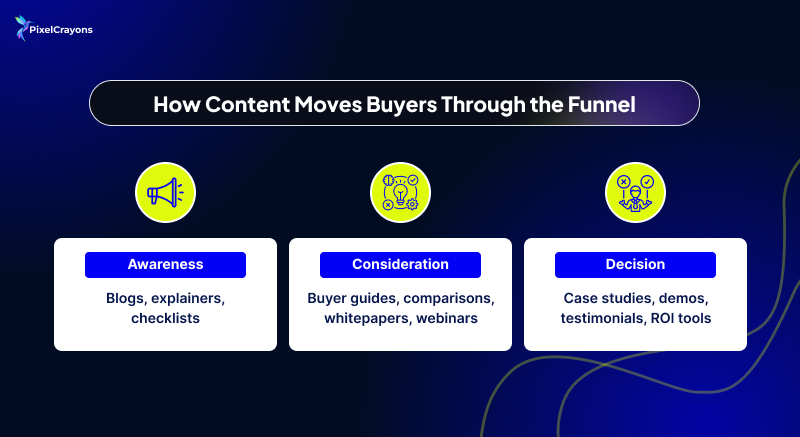
Different stages need different content:
Awareness: Blogs, explainers, checklists→ build understanding without selling.
Consideration: Buyer guides, comparisons, whitepapers, webinars→ help evaluation.
Decision: Case studies, demos, testimonials, ROI tools → reduce doubt and support purchase decisions.
4. Create Strong Calls to Action
Every page should guide the next step based on intent:
- Read a blog → subscribe
- Read a guide → download resource
- Review case studies → request demo
- Use ROI tool → book consultation
A CTA only works when it matches where the buyer actually is. Don’t ask for a demo on someone’s first visit.
5. Don’t Forget Existing Customers
Content isn’t just for winning new business. It also keeps the customers you already have. Onboarding guides, tutorials, and best practices help customers succeed. Happy customers renew and upgrade.
Doing all of this well is hard at scale. That’s why many teams turn to partners like PixelCrayons for content marketing services, content writing services, and broader digital marketing services. This keeps creation, distribution, and results consistent instead of scattered.
From blogs to demos, build content systems that guide buyers through every stage of the funnel and drive consistent conversions.
Phase 4: Distribute Your Content Where Buyers Are
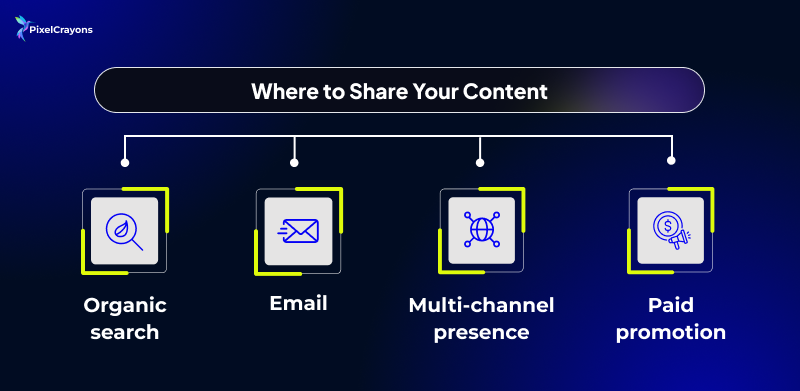
Buyers find information everywhere: search engines, social media, email, online communities, AI search tools, and word of mouth from people they trust. Every piece of content needs a plan to reach the right person at the right time.
Not every channel deserves equal effort. Focus where your audience already spends time.
- Organic search is still one of your strongest long term channels. But don’t only write for beginners. Someone searching “what is content marketing” is early. Someone searching “best content marketing services” is close to buying. Cover both.
- Email still delivers strong returns. Most companies see an ROI between 20:1 and 45:1, and top performers pass 45:1. It also moves fast. 76% of teams can write and send a campaign in three days or less. Promotional emails still drive the most engagement overall, but newsletters are catching up fast, growing 12% year over year as more B2C brands invest in long term relationships instead of one off sales.
- Multi channel presence means showing up across multiple digital platforms: LinkedIn posts, thought leadership, newsletters, podcasts, guest articles, webinars, communities. Repetition across channels people trust beats search alone. Most teams overlook this.
- Paid promotion pushes your best material further once organic reach hits a wall. Think industry reports, buyer’s guides, case studies, comparison pages, and webinar sign ups. LinkedIn lets you target by industry, company size, job title, and seniority, so you reach the right decision makers instead of a broad crowd.
Instead of generating new content, try reusing the existing content in different formats. For instance, one excellent guide can turn into several LinkedIn posts, a webinar, a short video series, an infographic, an email sequence, and a checklist. Repurposing gets you more reach without more work.
Great content alone isn’t enough. Distribution decides whether real buyers ever see it. Combine search, email, social, paid, sales enablement, and repurposing, and you get a strategy that keeps producing qualified pipeline.
Reach high-intent buyers across SEO, email, paid, social, and sales channels with structured, multi-touch content distribution.
Phase 5: Measure, Learn, and Improve What Drives Pipeline
B2B buyers rarely take a straight path. They read an article, compare options, check a case study, watch a webinar, then book a demo. If you only give credit to the last click, you miss how the decision actually happened.
Attribution fixes that. Each model shows a different part of the story:
- First touch shows what brought them in
- Multi touch shows what shaped the decision
- Time decay shows what stayed relevant the whole way through
Connect your content data to your CRM, whether that’s Salesforce or HubSpot. Now you can trace content straight to leads, opportunities, and closed revenue.
From there, the fixes are obvious. Traffic but no conversions? Fix your CTAs or page structure. Case studies closing deals? Show them earlier. Comparison pages converting well? Push them higher in the decision stage. Measure, learn, refine, repeat.
Also Read: Content Marketing in 2026: Emerging Trends You Can’t Ignore
Make Content Work for Pipeline, Not Just Traffic
Good content starts with real buyer intent. Add a clear content attribution strategy and a real content-led growth strategy, and content stops being just a marketing task. It becomes part of how you sell.
Execution still matters. Many companies lean on content marketing services, content writing services, digital marketing services, or content consulting services to keep quality and strategy on track.
In the end, a good content strategy is simple. Attract the right buyers. Help them decide. Move them into the pipeline.
Move from content that gets traffic to content that consistently generates qualified pipeline.
Frequently Asked Questions (FAQs)
1. What is a content strategy for pipeline generation?
Ans. A content strategy for pipeline generation focuses on creating content that drives not just traffic, but qualified leads and revenue. It aligns blogs, guides, and case studies with buyer intent and sales outcomes. With PixelCrayons’ content marketing services, content writing services, and content consulting services, businesses can build a structured system that turns content into predictable pipeline.
2. How is a content strategy for sales pipeline different from regular content strategy?
Ans. A content strategy for sales pipeline is built around conversions and revenue, not just visibility. It connects each content piece to a stage in the buyer journey. Unlike traditional content strategy, it prioritizes intent and decision-making. PixelCrayons supports this with digital marketing services and digital marketing strategies designed to convert content into measurable business outcomes.
3. Why is content attribution strategy important?
Ans. A content attribution strategy shows how different content pieces contribute to leads and sales. Buyers rarely convert from one touchpoint, so attribution helps track influence across the journey. It strengthens a content-led growth strategy by linking content to revenue. PixelCrayons uses content consulting services to help businesses measure what actually drives pipeline performance.
4. What is a content-led growth strategy?
Ans. A content-led growth strategy uses content as the main engine for acquisition and conversion. It connects awareness, consideration, and decision-stage content into one system. This improves lead quality and conversion rates. PixelCrayons helps implement this through content marketing services and content writing services that ensure consistency, scale, and buyer-focused messaging.
5. What are content promotion secrets for better pipeline results?
Ans. Content promotion secrets include targeting high-intent keywords, repurposing content across channels, and using multi-channel distribution. Strong promotion ensures content reaches buyers at the right time. Combined with PixelCrayons’ digital marketing services and content consulting services, businesses can turn content into a consistent driver of qualified pipeline instead of isolated traffic.