Choosing an educational institution typically involves extensive research, comparisons, and careful consideration of factors such as academic quality, cost, location, and career outcomes.
The college search timeline is gradually shifting with more students embarking on the college search earlier than before. For example, the classes of 2024 and 2025 reversed the post-pandemic trend of delayed searches and started inquiring much earlier.
For many educational establishments, this is an issue since most traditional marketing campaigns only begin when admission season starts. However, by the time prospects begin their search, many students have already found and narrowed down their options based on the content they found online.
The solution lies in adopting content marketing for education that keeps institutions visible throughout the student decision-making journey. Effective marketing for higher education brands focuses on providing valuable information long before admissions open, ensuring prospective students consistently discover helpful resources while researching their options.

Stay visible throughout the student decision-making process and turn more prospects into enrollments.
Table of Contents
Why the Enrollment Cycle Is Longer Than Most Marketers Expect
Many education marketers wrongly believe that marketing to prospects starts as soon as the application window opens or even as they begin their research. The enrollment journey often begins months or even a year before applications open, as students carefully evaluate one of the most significant financial and life decisions they will make. Therefore, these prospects gather all the information that seems relevant to the decision for months. This research can entail:
- Considering potential opportunities
- Searching for details about careers
- Comparing different options
- Analyzing costs and grants
- Consulting with teachers and parents
- Visiting the institution
- Learning more about the ranking
- Applying
Furthermore, the student is not the only one involved in the process. Parents, advisors, and sponsors play an equally important role. Therefore, the marketer needs to keep in mind that the information has to be relevant to everyone involved in the process and not just the student.
Moreover, throughout the entire research process, the prospect touches numerous sources such as:
- Google search
- Blogs
- Websites
- Testimonials
- Social media
- YouTube
- University visits
- Webinars
- Email marketing
- Admission counselors
Therefore, there is ample information that impacts the decision, and the marketer can intervene at multiple points during the prospect’s journey. Since education is an expensive and highly important purchase, the prospect will not make a decision based on just one touchpoint, and they will return to the sites multiple times throughout their research.
Thus, to ensure that marketing is efficient and reaches prospects as they continue their research, the marketer must consistently offer relevant information. Moreover, according to the latest trends, the marketer should focus on engagement rather than sales.
This is because in most cases, there are multiple visits and information consumption from the content before the student decides to apply. This is why a well-planned higher education marketing strategy should focus on building trust over time instead of relying solely on short-term admission campaigns.
Also Read: How to Increase Student Enrollment with Digital Marketing?
Understanding the Enrollment Journey
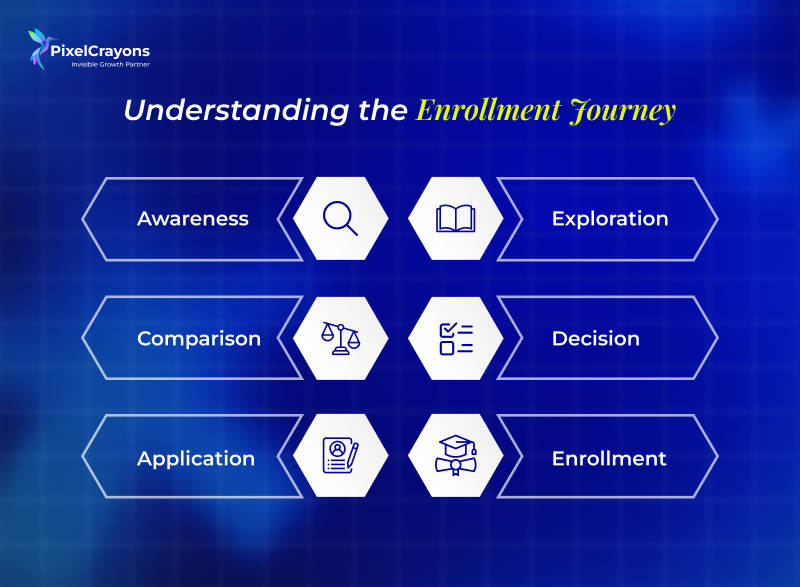
A successful student enrollment marketing strategy begins with understanding how prospective students interact with an institution before making a final decision. Though every student’s journey is different, most enrollment experiences follow similar stages that can be supported through targeted content.
|
Stage |
What Prospective Students Are Thinking |
Questions They Need Answered |
Content’s Role |
|
Awareness |
“What career path should I choose?” |
Which programs exist? Which institutions are worth exploring? |
Inspire, educate, and increase visibility through SEO and educational content. |
|
Exploration |
“Which institutions fit my goals?” |
What courses are offered? What makes each institution different? |
Provide detailed information that helps students evaluate their options. |
|
Comparison |
“Which institution is the best choice?” |
How do tuition, placements, faculty, and campus life compare? |
Build credibility with transparent information, testimonials, and outcomes. |
|
Decision |
“Am I ready to apply?” |
What documents do I need? What scholarships are available? |
Remove uncertainty with practical guidance and admissions support. |
|
Application |
“I want to complete my application correctly.” |
What are the deadlines? What are the next steps? |
Reduce friction through checklists, FAQs, reminders, and admissions resources. |
|
Enrollment |
“I’ve been accepted. What happens next?” |
How do I prepare for campus life? |
Strengthen engagement with onboarding content, welcome communications, and community-building resources. |
Also Read: 9 Proven Lead Generation Strategies for Higher Education Institutes
Each stage requires different content, addressing students’ interests at a certain point to drive them further. The key to content marketing success lies in targeting those in their exploration phase based on where they are in their journey.
The same principle enables organizations to create a powerful admissions marketing engine that not only drives qualified traffic to a site but also keeps those prospects engaged throughout the application process, and increasingly, institutions are turning to dedicated digital marketing solutions for student enrollment to coordinate this engine across every channel a prospect touches.
Build a content strategy that attracts, engages, and converts prospective students.
Stage 1 – Building Awareness Early
At this stage, students are exploring colleges but haven’t chosen one yet. So, what can educational organizations do to attract these prospective students?
How can you build awareness with the right content?
Effective content includes:
- Career guidance blogs and industry insights
- Degree and specialization explainers
- Future job market reports
- Resources addressing common student concerns
- SEO-friendly content targeting informational searches
Search visibility continues to grow in importance. A recent survey found that 64% of prospective students are using search engines more than they did just a year ago, making SEO-driven educational content increasingly valuable during the awareness stage.
This is where marketing for education brands becomes especially valuable. Publishing SEO-driven blogs, career resources, and educational guides allows institutions to appear when students begin asking important questions online. This holds particularly true for institutions offering virtual or hybrid programs, where digital marketing for online education is often the primary, and sometimes only, channel through which prospective students discover a program before ever speaking with an advisor.
Stage 2 – Helping Prospects Explore Their Options
After identifying potential career options, students move on to the research phase. It is here that they start looking into different universities and courses.
What students want to know in this area are things such as:
- What the courses offer
- Opportunities upon graduation
- The quality and background of the faculty
- Campus experience
- Student success stories
Content suggestions during this phase include:
- Course guides
- Program comparisons
- Faculty bios
- Campus content
- Student testimonials
Institutions that combine informative content with social media marketing services can extend the reach of these resources, meeting prospective students on the platforms they already use every day. For institutions with a growing catalog of virtual programs, pairing this content with a focused digital marketing for online learning approach helps ensure that program comparisons and course guides reach students who are specifically evaluating remote or self-paced study options.
Stage 3 – Building Trust During Evaluation
As choices narrow, trust becomes one of the most significant factors. Moreover, students are no longer interested in which colleges offer the desired programs. Rather, they begin to wonder which educational institutions they can trust.
There are several ways by which education providers can build such trust, for example:
- Word-of-mouth
- Information about graduates
- Placement statistics
- Accreditation and rankings
- Campus visits
- Faculty expertise
Transparency about the benefits students will gain after enrolling in classes, the amount of money spent on education, and other factors will help attract more trusting customers.
Stage 4 – Supporting Application Decisions
At this stage, students have already decided to apply. What they need most is timely guidance and assistance throughout the application process. Therefore, it is essential to provide:
- Application timeline and important dates
- Admission guide
- Scholarship and financial aid
- FAQs
- Financial planning resources
In this way, the universities can help students have a smooth process and apply without any difficulties. Many institutions also use marketing automation to send application reminders, scholarship updates, and personalized emails that help students stay on track throughout the admission process.
Find hidden conversion barriers, stop revenue leaks, and grow sales.
Stage 5 – Keeping Students Engaged Until Enrollment
Acceptance does not always mean a deal is closed. Students can still compare their options and feel reluctant even when the offer comes before classes start.
Consistent student communications can help build excitement and further commitment by
- Allowing for personalized acceptance messaging
- Orientation resources
- Student communities and ambassador programs
- Onboarding checklists
- Welcoming campaigns featuring campus updates and student spotlights
Turning the Enrollment Cycle Into a Content Advantage
A 6–12 month enrollment journey provides education brands with numerous opportunities to influence student decisions. Strong marketing for education brands ensures every stage of the journey is supported with relevant content that informs, educates, and builds confidence.
Creating a Content Strategy Around the Enrollment Cycle
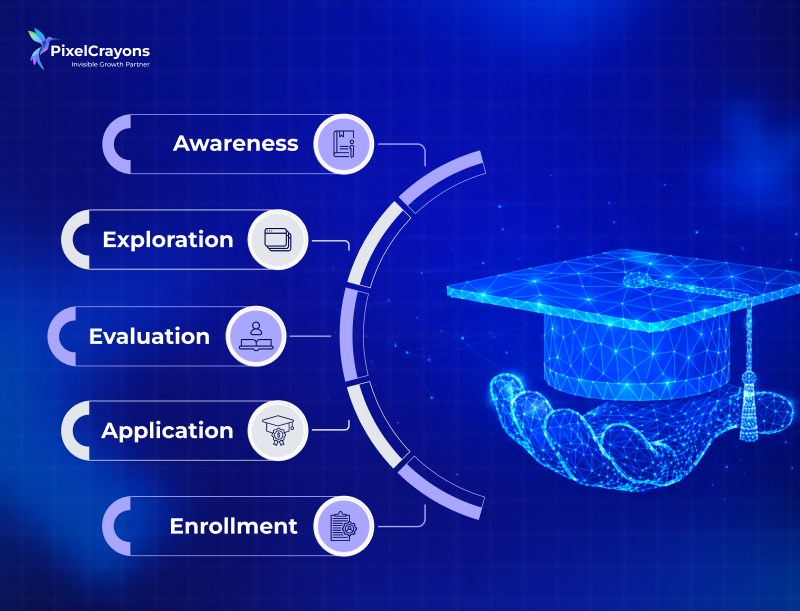
Education entities should develop content strategies around the enrollment cycle so that they can effectively serve prospective students.
Create Content That Makes Sense to the Students
The content should be developed to help prospective students through the different stages of the enrollment cycle.
- Awareness: Career Advice, Industry Advice, Educational Advice
- Exploration: Program Pages, Faculty Spotlights, Student Ambassadors, Student Success Stories
- Evaluation: Testimonials, Program Rankings, Outcomes Data, Accreditation Information
- Application: Admissions Resources, Scholarship Information and Resources, FAQs
- Post-Acceptance: Onboarding Resources and Information
Look at Ways to Use Content More Than Once
Develop content that can be repurposed across blog posts, videos, webinars, email campaigns, and social media marketing services. This approach maximizes content value while maintaining consistent messaging across every marketing channel. Institutions running fully online or blended programs often find that building a single, repeatable eLearning marketing solution around this repurposed content, one blog becoming a webinar script, an email series, and a set of social posts, is far more efficient than producing fresh assets for each channel.”
Balance Evergreen Content With Seasonal Content
Evergreen content, which remains relevant year-round, should be combined with seasonal enrollment or admissions-related content to ensure the institution stays visible. Evergreen topics may include career advice or explanations of different educational options, while seasonal content helps prospective students with applications and enrollment.
Be Consistent
Having consistent content is one of the foundations of successful content marketing services for education. Regularly publishing valuable resources helps institutions build authority while remaining visible throughout the admissions cycle.
Also Read: 9 Content Marketing Secrets to Keep Your Audience Hooked
Measuring the Success of Educational Brands Beyond Applications
For education brands, the number of applications is an essential metric that demonstrates the final stage of a student’s decision-making process. However, considering only this metric, you will get an incomplete picture of how your audience interacts with your brand.
Understanding the critical role played by content in the conversion process enables you to see beyond applications and analyze the entire student journey. Institutions that invest in digital marketing services for education should evaluate content performance across the entire enrollment journey rather than focusing only on completed applications.
Organic Traffic Growth:
- Growth in non-branded searches.
- Rankings for program-related keywords.
- Increased visits to informational content.
- New users discovering the institution through educational resources.
Engagement Metrics
Traffic growth is great, but you also want to see if the audience is interested in your content. In other words, engagement metrics will show you what your prospects are reading, watching, and downloading. Here are some key engagement metrics:
- Time spent on page
- Pages per session
- Downloads
- Video views
- Webinar sign-ups
- Subscription growth
As you can see, these metrics will indicate if your prospects are engaged. The engagement level will demonstrate the degree to which students are interested in your content.
Returning Visitors
As you know, the student conversion process takes a long time, so it is not surprising that most prospects become acquainted with your brand more than once before submitting an application. That is why the number of returning visitors is one of the essential metrics for measuring the impact of your content marketing on enrollment.
Inquiry-to-Application Conversion
You may notice that not all inquiries lead to applications. That is why this metric will show how effective your content is at nurturing prospects through the conversion funnel. For instance, a prospect may find your brand via career guides, participate in a webinar, download a checklist, and eventually apply to your university.
Application-to-Enrollment Conversion
As you realize, not all applicants are bound to become enrolled in your educational institution. Tracking the application-to-enrollment conversion rate will help you identify if there is a specific stage where students are likely to abandon the enrollment process.
Content-Assisted Conversion
It is essential to understand that enrolling in your educational institution is not driven by a single page. In fact, students may interact with dozens of web pages, each of which has an impact on their ultimate decision. For instance, your prospects may interact with the following types of content:
- Career guides
- Resource pages
- Testimonials
- Applications
- Scholarship pages
- Comparison charts of different programs
The application page itself is not the sole driver of conversion. Each piece of content plays a vital role in assisting prospects in making a choice and eliminating any uncertainties. Measuring these interactions allows student enrollment marketing efforts to be refined over time, helping institutions understand which content contributes most to enrollment decisions.
Admission season alone won’t drive results. Stay visible throughout the student's journey to increase qualified applications.
Common Mistakes Education Marketers Should Avoid
Even the best educational institutions can fail to attract students due to a bad content strategy or marketing mistakes. Some of them include:
- Marketing only in the admission season: Students start researching educational opportunities way before the admission season starts. Therefore, it is essential to have a well-thought-out content strategy that will keep your educational institution in front of students throughout the year.
- Not focusing on parents and guardians: For many families, the most important factors in choosing a university are not academic, but rather financial, career-related, safety, and support ones. Therefore, your content should address their questions and concerns as well.
- Focusing too much on self-promotion: Students are not interested in hearing what your educational institution can say about itself. Instead, they want relevant information that will help them make the right choice.
- Not optimizing content for search engines: SEO is essential if you want to attract students on the first page of search results. Relying only on paid campaigns while overlooking digital marketing services for education such as SEO, content marketing, and email nurturing can significantly reduce long-term visibility.
- Not keeping evergreen content up to date: If your content is not relevant or provides incorrect information, you will lose students’ trust and credibility.
Final Thoughts
A 6–12 month enrollment cycle should not be viewed as a marketing challenge. Instead, it is an opportunity for marketing for education brands that helps them build meaningful relationships with prospective students through consistent, meaningful content delivered across every stage of their decision-making journey.
Research shows that students are engaging with institutions earlier than before, particularly during freshman and sophomore years of high school, expanding the window in which content can influence enrollment decisions.
Supported by marketing automation, institutions can continue delivering personalized communication after each interaction, ensuring students receive relevant information at the right stage of their enrollment journey.
Frequently Asked Questions (FAQs)
1. What are the best Lead generation strategies for higher education institutes?
Ans. The most effective lead generation strategies for higher education institutes focus on attracting prospective students long before application season begins. This includes creating SEO-driven educational content, offering downloadable resources, hosting webinars, sharing student success stories, and using personalized email campaigns to nurture prospects throughout the enrollment journey.
2. How to increase student enrollment with digital marketing?
Ans. Increasing student enrollment requires a combination of consistent content marketing, search engine optimization (SEO), paid advertising, social management, and marketing automation. The goal is to stay visible throughout the student decision-making process, answer common questions, and build trust before prospects are ready to apply.
3. Why is year-round content marketing important for educational brands?
Ans. Students often spend months researching institutions before submitting an application. Publishing valuable content throughout the year helps institutions remain visible during every stage of the enrollment journey, build credibility, and stay top of mind when prospective students are ready to make a decision.
4. What types of content influence prospective students during the enrollment journey?
Ans. A successful content strategy includes career guidance articles, program pages, faculty profiles, student testimonials, comparison guides, scholarship information, FAQs, webinars, and onboarding resources. Together, these content formats help answer student questions and reduce uncertainty throughout the enrollment process.
Discover the hidden issues reducing your conversions and profitability. Get a clear action plan to optimise your store and turn more existing traffic into revenue.