Most people believe that scaling marketing efforts requires more hiring. Growth is directly tied to headcount.
However, today, AI is performing core marketing functions that once required entire teams. Campaigns are optimized in real time, content is generated in seconds, and audience targeting happens at an individual level.
This led to a critical question every brand is now asking: Can AI fully replace digital marketing teams in the near future?
Or more specifically, in the battle of AI vs human marketing execution, who actually drives growth today?
In this blog post, we break down where AI is genuinely transformative, where it still fails, and why the future is not a replacement but a restructuring.
Will AI Replace Marketers? The Real Answer
AI is reshaping roles, not eliminating them. While AI services fuel growth through speed, scale, and optimization, the human role is more important for brand positioning, decision-making, and emotional storytelling. This human-AI collaboration becomes the foundation of strategic marketing execution in today’s tech-driven era.
|
Aspects
|
Artificial Intelligence (AI)
|
Human Marketers
|
Hybrid (The “Winner”)
|
|
Strategy & Vision
|
Predictive: Forecasts, trends and sales using historical data such as engagement signals and purchase behavior.
|
Strategic: Defines brand positioning, long-term goals, and adapts strategy after algorithm or market shifts.
|
Insight-led: AI identifies patterns and opportunities; humans define direction and business context.
|
|
Content Creation
|
Scalable: Quickly generates outlines, drafts, and repurposes a single asset into multiple formats (blogs, social posts, scripts).
|
Original: Brings storytelling, creativity, and emotional depth that builds brand trust and differentiation.
|
Quality-at-scale: AI handles first drafts and volume; humans refine messaging and tone.
|
|
SEO & Search
|
Technical: Automates keyword clustering, site audits, and identifies technical issues like broken links and page errors.
|
Authoritative: Focuses on EEAT (Experience, Expertise, Authority, Trust) and high-quality link-building strategies.
|
High-ranking: AI accelerates research and execution; human strategy ensures relevance and authority.
|
|
Paid Ads (PPC)
|
Optimization: Uses smart bidding and real-time budget allocation across large-scale ad auctions.
|
Persuasive: Develops emotional messaging, creative direction, and manages brand sensitivity and policy nuances.
|
Maximum ROI: AI handles bidding and optimization; humans refine creative hooks and messaging for higher CTR and Quality Score.
|
|
Data Analysis
|
Precise: Processes large datasets instantly to uncover patterns that are difficult to detect manually.
|
Interpretive: Understands the “why” behind behavior, including psychology and market dynamics.
|
Data-driven: AI delivers insights at scale; humans convert them into actionable strategy. Teams using AI report up to 39% better data insights.
|
|
Customer Experience
|
Automated: Provides 24/7 support through chatbots and handles repetitive queries and lead nurturing.
|
Empathetic: Manages sensitive interactions requiring emotional intelligence and trust-building.
|
Hyper-personalized: AI tailors experiences in real time; humans ensure authenticity and brand alignment.
|
Stop Choosing Between AI and Marketers
Use a hybrid system that drives real growth
Where AI Outperforms Marketing Teams
AI is not replacing marketing entirely, but it is already outperforming humans in execution-heavy workflows. What it does best is remove friction from scale.
1. Execution at Speed and Scale
Traditional marketing execution is slow because it is sequential: research → plan → execute → test → optimize.
AI compresses this entire cycle. For example:
- Keyword research that once took a week is now done in minutes
- Technical SEO audits run continuously in the background
- Paid ad bidding adjusts in real time without manual input
This is where AI automation vs strategic marketing execution becomes most visible. AI is not thinking strategically, but it is executing faster than any human team can.
For example, an eCommerce brand running 200+ ad variations no longer needs a large performance team. AI dynamically tests, learns, and reallocates budget automatically.
2. Hyper-Personalization
One of AI’s biggest breakthroughs is the shift to personalization at scale. Earlier marketing looked like: “Target women aged 25–35 interested in fitness.” Now it looks like: “Show this specific ad to this specific user based on their real-time behavior.”
Example:
- A user browsing winter jackets in a cold region sees heavy insulation ads
- Another user in a warm region sees lightweight alternatives
Studies show this level of personalization can deliver up to 50% higher click-through rates. This is a major reason brands are increasing the adoption of AI services in performance marketing systems.
3. Efficiency Gains That Redefine Team Size
Instead of scaling headcount, companies are scaling output. For example, HubSpot studies highlight how Agicap saved 750 hours per week by automating content research and production workflows.
What this means in practice:
- 3–4 marketers can now do the work of 15
- Digital marketing agency can manage multiple clients with smaller teams
- Founders can delay hiring without slowing growth
This is not just efficiency; it is a structural change in how marketing teams are built.
Also Read: 11 Digital Marketing Trends That Will Continue in 2026
4. Predictive Intelligence for Smarter Decisions
Marketing has traditionally been reactive, optimizing after performance drops. AI shifts this model by enabling forward-looking decision-making. Instead of just reporting what happened, AI can:
- Flag campaigns where CTR is starting to drop before performance crashes
- Identify audience segments that are showing early signs of higher conversion rates
- Detect rising or falling search demand for keywords before it shows up in manual reporting
- Highlight when the cost per acquisition (CPA) is trending upward
So, instead of waiting for a campaign to underperform, AI gives early warning signs, like declining engagement or rising cost per acquisition.
5. Content Repurposing Across Channels
A single product launch often gets used once, when it could fuel an entire cross-channel strategy. With the right approach, one core idea can be systematically adapted into:
This enables brands to maintain a consistent presence across platforms without expanding teams.
However, this efficiency also raises a deeper question: Is speed creating meaningful marketing, or just more content?
Turn AI Efficiency Into Real Marketing ROI
AI handles execution. We handle outcomes.
Where AI Falls Short in Marketing
Despite its capabilities, AI cannot replace marketing teams. It can execute, but it cannot think like a brand.
1. Inaccuracy and Context Blindness
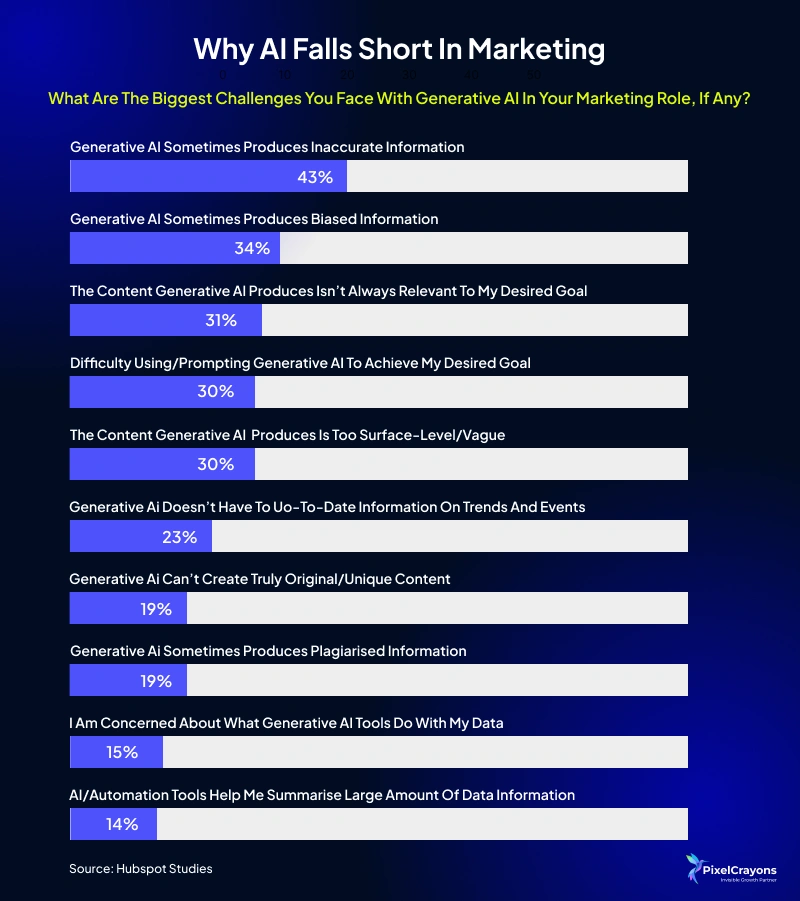
43% of marketers cite hallucinations and inaccuracies as a major concern. AI tools have the following tendencies:
- Invent statistics
- Misinterpret niche industry context
- Suggest irrelevant keywords with high confidence
In marketing, incorrect execution at scale becomes an amplified risk. This is a major reason why AI marketing fails without a human strategy.
2. Lack of Emotional Intelligence
Marketing is not just about delivering the right message, but delivering it with the right tone, context, and sensitivity. AI is inefficient when it comes to:
- Understanding cultural sensitivity
- Interpreting emotional nuance
- Building an authentic brand identity
For instance, a skincare brand running a sensitive “skin confidence” campaign cannot rely solely on AI-generated messaging. Tone misalignment can damage trust instantly.
This is where the benefits of human-led marketing execution show up, as humans interpret emotion, timing, and cultural relevance in ways AI cannot.
3. Generic Output in Competitive Markets
Around 30% of marketers report that AI content feels too generic or surface-level
For instance, when AI is used for ad copies, it sounds like “Boost your performance with our powerful solution.”
It is grammatically correct, but strategically weak.
4. Ethical, Privacy, and Bias Risks
Human oversight remains non-negotiable, as 34% of marketers cite algorithmic bias and 41% cite data privacy concerns. So, an automated ad system may unintentionally:
- Exclude certain demographics
- Over-optimize for narrow audience clusters
- Use behavioral data without transparent logic
Also Read: How to Power Your SEO Content With AI
AI Still Requires Human Validation
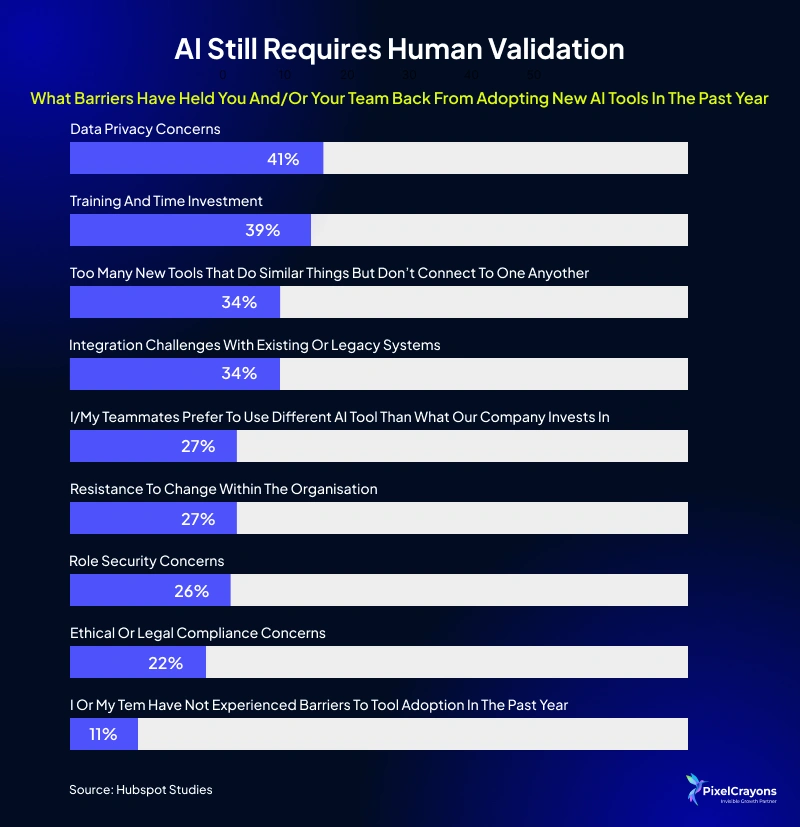
Despite advancements, AI is rarely used in isolation. Only 7% of marketers publish AI-generated content without edits. This directly reinforces the reality of AI vs human marketing execution, where AI executes, humans validate.
How to Scale Marketing Without Hiring More People
So, if AI cannot replace teams, how to scale without increasing headcount?
Instead of building large in-house teams, brands now rely on a digital marketing agency, like PixelCrayons, that combines:
- Strategic expertise
- AI-driven execution systems
- Specialized performance teams
Additionally, you get integrated capabilities such as SEO services, paid media management, and conversion optimization. So, if traditionally, you needed a 10–12 person marketing team, we enable you to achieve similar output without increasing headcount.
Now, brands can use agencies to access senior expertise on demand while staying lean internally. This reduces fixed costs while maintaining performance quality.
Also Read: How to Scale Your Startup with AI & Machine Learning
Stop Hiring. Start Scaling Marketing Output.
Get enterprise-level execution without expanding your team.
Final Takeaway
AI will not fully replace digital marketing teams in coming years. But it will permanently redefine what a “team” looks like. The winners in this new era will:
- Use AI to scale execution
- Use humans to drive strategy and meaning
- Combine both into a unified marketing system
Because in the end, AI can optimize performance, but only humans can create trust, differentiation, and brand value.
Frequently Asked Questions
1. Can AI fully replace digital marketing teams?
Ans: While AI improves execution speed, AI vs human marketing execution shows humans still lead strategy. Businesses often rely on partners like PixelCrayons digital marketing agency to balance AI efficiency with human-led execution.
2. What is AI vs human marketing execution in digital marketing?
Ans: AI vs human marketing execution means letting AI handle data, ads, and SEO execution, while humans manage creativity and decision-making.
3. Why does AI marketing fail without a human strategy?
Ans: AI marketing often fails without a human strategy because it lacks context, emotional intelligence, and brand alignment. This is why AI marketing fails without human strategy in competitive markets. Businesses using SEO Services and expert-led oversight from agencies like PixelCrayons achieve stronger consistency and higher ROI.
4. Why hire a digital marketing agency in the AI era?
Ans: You should hire a digital marketing agency in the AI era to combine automation with strategic expertise. While AI improves speed, agencies provide the benefits of human-led marketing execution, such as creativity, positioning, and optimization. PixelCrayons integrates AI services with full-funnel digital marketing for scalable growth.
5. What are the benefits of human-led marketing execution with AI?
Ans: The benefits of human-led marketing execution include better storytelling, brand positioning, and decision-making, which AI alone cannot achieve. When combined with automation, it improves efficiency and ROI.

Transforming the Future with White Label Blockchain and AI
I’m a White Label Blockchain & AI Expert with 7+ years of experience, partnering with digital agencies and consulting firms to deliver white-label blockchain, AI, and Web3 solutions for their clients. I work behind the scenes to help agencies scale faster, expand service offerings, and deliver secure, future-ready solutions—under their own brand.
What I Offer to Agencies
White-Label Blockchain Solutions
- End-to-end development of smart contracts, DApps, and enterprise-grade blockchain systems using Ethereum, Hyperledger, Solana, and more.
- Hands-on experience with DeFi platforms, NFT ecosystems, and Web3 infrastructure—delivered seamlessly as your in-house capability.
White-Label AI Integration
- Designing and deploying machine learning models for predictive analytics, automation, and operational efficiency.
- Implementing NLP and AI-powered solutions for intelligent, data-driven decision-making.
- Combining AI with blockchain to build secure, decentralized, and scalable applications for client use cases.
Scalable Innovation for Client Projects
- Helping agencies deliver advanced solutions for identity management, traceability, security, and compliance by merging AI and blockchain technologies—without increasing internal overhead.
Your Trusted White-Label Tech Partner
I’m passionate about enabling agencies to win more projects, reduce delivery risk, and increase margins with reliable white-label Blockchain, AI, and Web3 development support. If you’re looking for a long-term technical partner to strengthen your offerings, let’s collaborate and build impactful solutions—together.
Let’s Connect Linkedin | Facebook
#WhiteLabelServices #BlockchainDevelopment #AIIntegration #Web3 #MachineLearning #DeFi #SmartContracts #AgencyGrowth #EmergingTechnologies